|
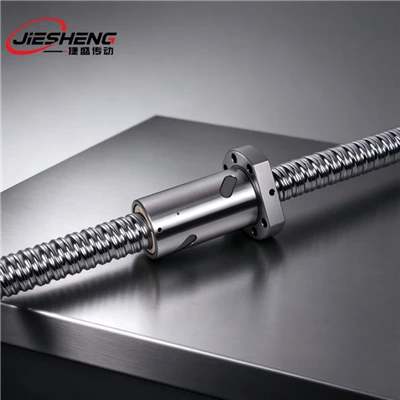
| Assembled Set · Screw, Nut, Supports, Ends
Flanged Ball Screw AssemblyNobody buys a screw and a nut. You buy the error the four parts make when they are bolted together. An assembly is not a parts list - it is a tolerance stack. Three mechanical terms add up to about 0.055 mm, and the largest of them owns 83% of the total. Knowing which term that is decides where your money should go.
 0.055 mm Combined ±0.05 mm Lead Term 4 Terms in the Stack 0.08 mm Worst-Case Sum
|
01 / The arithmetic of a single axis
Every positioning axis made of these parts carries three independent errors: the lead error of the screw, the axial play of the support bearing pair, and the misalignment between the screw axis and the housing. In the worst case they simply add. In reality they are independent, so they combine as the root sum of squares - and that is the figure worth quoting to a customer.

Share = term variance divided by total variance. RSS assumes the three terms are independent and roughly centred, which is an approximation - useful for deciding where to spend, not for accepting an inspection report.
Lead error 83%Bearing play 13%Alignment 3%

Because the shares are squared, the biggest term is not slightly bigger - it is nearly everything.
 Why the Numbers Add Like This
Tolerances do not add like lengths, they add like areas. A term of 0.05 mm contributes 0.0025 mm² of variance, while a term of 0.01 mm contributes only 0.0001 - twenty-five times less, for a term five times smaller. Squaring is what makes the small terms nearly irrelevant.
This is the reason a supplier can offer excellent bearings and still deliver an axis that measures 0.055 mm: the bearings were never the problem.
02 / Where the money works
Three Upgrades, Three Very Different Returns
Take the same assembly and improve one term at a time. The percentages below are the reduction in the combined error - and they explain why precision bearings are a poor first purchase.

Each row changes one term only, starting from 0.05 / 0.02 / 0.01 mm. The C5 row is the only upgrade that changes the answer by half.

03 / The term nobody puts in the table
Heat Beats All ThreeThe stack above is mechanical and static. A running screw is neither. Balls recirculating through the nut heat the shaft, the shaft grows, and the growth appears directly as position error - with a coefficient nobody can improve by buying a better grade.

Growth = α · ΔT · L with α = 12 × 10⁻⁵ per K. Pre-tension force = E · (ΔL/L) · A, with A taken at the root diameter and E = 206 GPa. These are sizing numbers, not a guarantee: the real rise depends on speed, preload and how the nut is cooled.
 Three Ways to Live With It
Share the temperature. If the screw, the frame and the measuring reference all warm together, the growth is common mode and cancels. This is why a glass scale on a machine tool frame is so effective - it moves with the frame, not with the screw.
Pre-tension the shaft. Stretching the screw at build time puts it in tension, so the first few degrees of warming only relieve tension instead of adding length. Roughly 3 kN buys back 5 K on a metre; beyond that the nut load and the buckling margin start to suffer.
Cool or slow it. Oil circulation or a lower duty cycle acts on the cause
rather than the symptom, and costs less than a C5 screw.
04 / What arrives on the pallet
Four Things, One Set


Check It Before You Bolt It Down
An assembly that arrives correct can still be installed wrong. The five checks below catch almost every installation error, and none of them needs a laser.
Do them in this order. Each one assumes the previous one passed - measuring parallelism on a screw that is already bent by a bad support height tells you nothing useful.

05 / Applications
Where a Matched Set Earns Its Keep


06 / FAQ
Questions About the Whole Set
Q: What exactly is included in an assembly?
A:Screw with machined ends, the flanged nut balled to that screw, and a matched support pair. Couplings, motor flanges and covers are options, quoted separately so you can see what each one costs.
What is not included is the carriage plate. That is the one part of the load path we cannot control, which is why the installation checks matter as much as the parts.
Q: Can I replace just the nut later?
A:In principle yes, in practice it becomes a re-balling: the replacement nut has to be filled with balls sized to the wear pattern of your existing screw. A new nut dropped onto a worn screw will either run loose or jam.
If you expect to replace the nut mid-life, order the spare at the same time as the assembly, so it is balled against the same groove.
Q:My parts all meet their specs, so why does the axis measure worse?
A:Because each spec is measured alone and the axis measures the sum. Three terms that are each in tolerance still combine into 0.055 mm against a largest single term of 0.05 - and against the small terms the gap is a multiple, not a margin.
Add thermal growth and the gap widens further. Ask for the combined figure with its assumptions before you conclude that a part is defective.
Q: Should I buy a C5 screw or pre-tension a C7?
A: Measure first. If the drift over an hour of production duty is larger than about 0.05 mm, the dominant error is thermal and pre-tension or cooling will beat any class upgrade on cost.
If the drift is small and the axis is still out, the lead error is doing the work and only a tighter class will move it.
Q: How much pre-tension is too much?
A:Enough to offset the expected rise and not much more. Every extra newton of tension is a newton the nut and the bearings carry continuously, and it eats into the buckling margin of a long, slender screw.
State the expected temperature rise with us and we will size it; do not simply tension to the highest figure the thread will take.
Q:Do I need the support pair from the same supplier?
A: It is the cheapest way to keep the stack small. Matched supports arrive at the same height and with known axial play, so two of the three terms are already characterised.
Mixing a good screw with unbranded blocks is exactly how an assembly ends up measuring worse than the screw's own certificate.

Send the Stroke, the Load and the Heat
Travel length, thrust, expected temperature rise and the error your process can tolerate. Those four decide the class, the pre-tension and whether a matched set is worth it at all.
Hot Tags: flanged ball screw assembly, China flanged ball screw assembly manufacturers, suppliers, factory, ball screws for dimensional accuracy testing, ball screws for functionality testing, ball screws for product development, ball screws for research facilities, ball screws with anti backlash features testing, Flanged Nut Precision Ball Screws