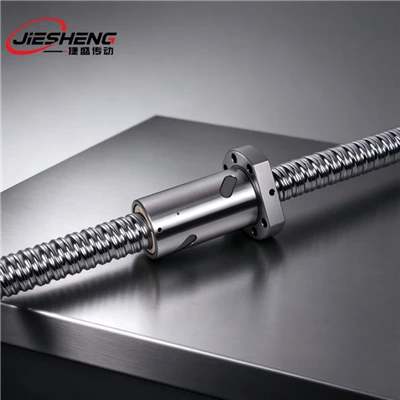
|
| SFU1605 · Ø16 × 5 mm
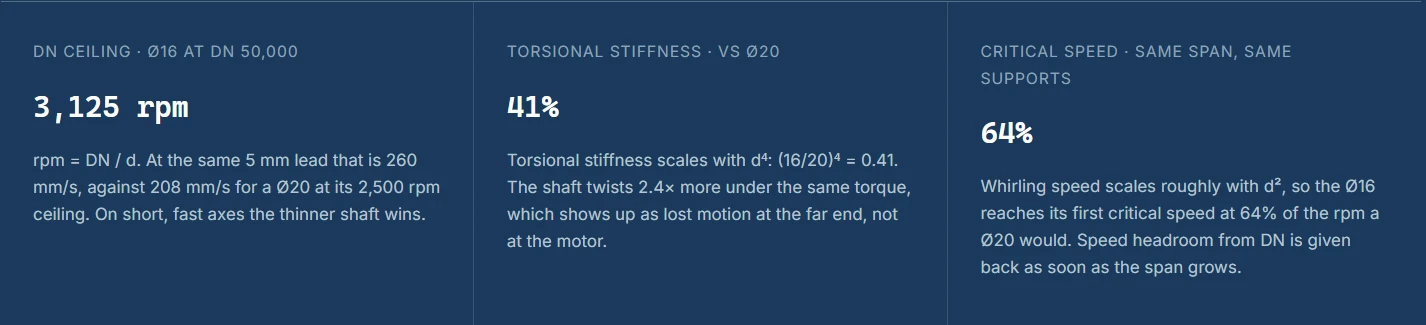
1605 Ball ScrewSame 0.025 mm resolution as a 2005, but 41% of its torsional stiffness - and a higher rpm ceiling. The 1605 is not simply a smaller 2005. Drop the shaft from Ø20 to Ø16 and two ceilings move in opposite directions: the DN rule lets it turn 25% faster, while the thinner shaft gives up 59% of its torsional stiffness.
 7.65 kN Ca, 3 Circuits Ø28 Nut Body 41% Torsion vs Ø20 0.025 mm Per Full Step
|
01 /What actually changes
Most buyers treat 1605 as "the small one". In practice only two things change at the drawing - the shaft diameter and the nut envelope - but five engineering numbers move, and they do not all move in the same direction.
The resolution stays identical, because both screws use a 5 mm lead: 0.025 mm per full step on a 1.8° stepper. That is the one place where the 1605 buys nothing back for its smaller size.

Load ratings are catalogue values for the 3-circuit single nut; stiffness figures are geometric ratios - torsional stiffness scales with d⁴, axial with d². rpm ceilings apply the DN 50,000 guide for grease lubrication and must be confirmed with the nut supplier for your duty cycle.

02 / Specifications
SFU1605 Datasheet
|
Model
|
SFU1605 - flange type, single nut, 3 or 4 circuits |
|
Shaft diameter / lead
|
Ø16 mm / 5 mm - one revolution = 5 mm travel |
|
Ball diameter
|
3.175 mm |
|
Dynamic load Ca
|
7.65 kN (3 circuits); higher with 4 circuits - request the value for the exact nut |
|
Static load C₀a
|
13.2 kN (3 circuits) |
|
Nut body / flange
|
Ø28 mm body, 48 mm flange width, 10 mm flange thickness |
|
Nut length
|
40 mm (3 circuits) / 50 mm (4 circuits) |
|
Shaft material
|
GCr15 chrome bearing steel (SUJ2 / SAE 52100 equivalent), induction hardened HRC 58–62 |
|
Accuracy class
|
C7 rolled ±0.05 mm / 300 mm; C5 ground ±0.018 mm / 300 mm |
|
Axial backlash
|
< 0.05 mm standard; ZF preload < 0.02 mm |
|
Support units
|
BK12 fixed side / BF12 supported side - matched to the Ø16 journal |
|
Lengths
|
To 3,000 mm; longer checked against critical speed and transport limits |
|
End machining
|
Journals, keyways and threaded ends to drawing; cut to your support-unit centres |
|
MOQ / lead time
|
2–5 pcs; 2–3 weeks for rolled C7, 3–4 weeks for ground C5 |
* Values above are typical for the standard SFU2005 series. Exact dimensions, dynamic load rating and critical speed depend on nut type, shaft length and end support configuration. Contact us with your drawing for a confirmed specification.
03 / Fit and finish
Four Things We Control on Every 1605
Hardness, Not Just Material
GCr15 induction hardened to HRC 58–62 over the raceway depth the load actually reaches - a soft core under a hard case is what keeps a thin shaft from cracking.
Journal Matched to BK12
End journals are turned to the support-unit bore and shoulder, so the bearing preload is set by the housing, not improvised at assembly with shims.
Lead Checked Over Full Length
Lead error is measured along the usable travel, not at one point - the accumulated error over a stroke is what a positioning axis actually experiences.
Nut and Shaft as a Set
Ball size and preload are matched to the specific shaft, so a replacement nut from another batch is not guaranteed to fit - order them together.
04 / Applications
Where the 1605 Is the Right Answer
Desktop CNC
Short travel, light cutter load
Multi-Axis Gantries
Three light axes in one frame
Dispensing & Glue Heads
Fast, no thrust
Vision Stages
Small envelope, smooth motion
Lab Instruments
Quiet, short stroke
Packaging Indexers
Rapid repeat moves
3D Printers
Low moving mass
Pick-and-Place
Light part handling

05 / Read the span before the catalogue
The Same Screw, Two Different Limits
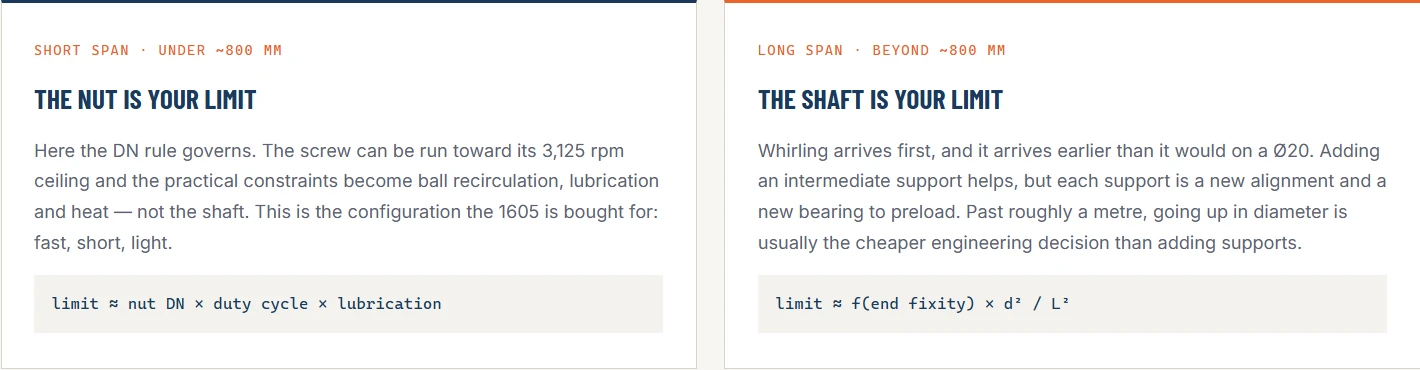
Span figures are design practice for a Ø16 shaft with standard end fixity, not a specification. Send the span and the end support arrangement and we will check the critical speed for your axis.
06 / Two ceilingsWhy a Small Shaft Can Be Faster - and Why It Cannot Be Longer
The two ceilings pull against each other: DN says "spin faster", whirling says "do not get long". A 1605 axis is therefore usually short and quick, or long and slow - and the span, not the nut, decides which one you get.
|
07 / FAQ
The Five Numbers Buyers Ask About
Q: Can a 1605 replace a 2005 on the same axis?
A: Mechanically yes - the lead is identical at 5 mm, so nothing changes in the motion profile or the resolution. What changes is what the axis can take.
Dynamic capacity falls to 89% and static to 77%, while the shaft's torsional stiffness falls to 41%. If the original axis was chosen with real margin and the span is short, the swap works. If it was already near its limit, you will feel the difference as deflection at the far end of the stroke.
Q: What is the maximum thrust a 1605 can carry?
A:Static rating is 13.2 kN, but that is a structural limit, not a working load. For continuous operation, plan well under it - bearing life and nut stiffness both fall away long before the screw fails.
Give us the thrust, the duty cycle and whether the load is reversing, and we will check it against life rather than against the catalogue headline. Where thrust is genuinely high, going up in diameter is the right move; the 1605 is not a load-bearing size.
Q:Can it really run at 3,000 rpm?
A:At 3,000 rpm the DN value is 48,000, inside the 50,000 guide for grease lubrication - so the arithmetic allows it, and the thin shaft is what makes it possible.
Whether your axis can is a different question: at that speed a 1605 needs adequate lubrication, a nut with a suitable return path, and a span short enough that whirling stays out of the way. Continuous high speed on grease alone will cook the nut; use oil or air-oil for sustained operation.
Q: Why does my 1605 vibrate at long stroke?
A: Almost always whirling, not backlash. The shaft is being run near its first critical speed, and the Ø16 reaches that point earlier than a Ø20 - 64% of the rpm, at the same span and support arrangement.
The fixes, in order of cost: shorten the span, add an intermediate support, lower the maximum rpm, or move up to a larger diameter. Reducing speed is often enough on a machine that only needs the fast traverse for positioning moves.
Q: Does a 4-circuit nut give more capacity?
A: Yes - more circuits means more balls in the loaded zone, so dynamic capacity rises, typically in the region of 25–35% depending on the manufacturer. The cost is length: the nut grows from about 40 mm to 50 mm, which eats into the envelope the 1605 was chosen to protect.
It also changes stiffness and preload behaviour. Ask for the 4-circuit datasheet rather than assuming the rating scales linearly.
Q:Which support units do I need?
A: BK12 on the driven end and BF12 on the supported end is the standard pairing for a Ø16 journal. The BK block carries the angular-contact pair that fixes the shaft axially; the BF end is a simple radial support that lets the shaft float as it expands.
Both must sit on the same machined datum as the rail - a 1605 axis loses more accuracy to a misaligned support than to the screw's own lead error.

Send the Span, Not Just the Model
Tell us the stroke, the span between supports, the thrust and the speed you need. On a 1605 those four numbers decide more than the part number does.
Hot Tags: sfu1605 ball screw, China sfu1605 ball screw manufacturers, suppliers, factory, ball screws for diy projects, ball screws for functionality testing, ball screws for mass production, ball screws for multiple diameters testing, ball screws with different lead values, stainless steel ball screws