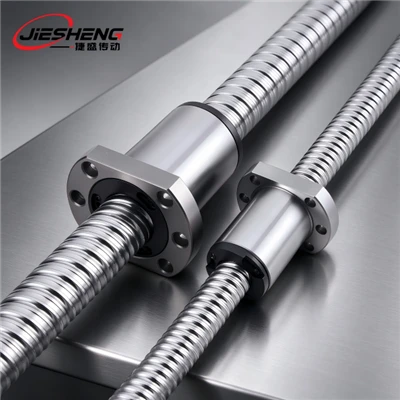
|
| SCI Series · Flangeless Cylindrical Nut · Ø16–80 mm
SCI Series Ball ScrewThe body is the mounting face - so what you are really specifying is a bore. On a Ø20 screw the SCI body is 34 mm. The flanged nut that carries the same balls is 58 mm across the flange. Those 24 mm are the whole product - and they are also the whole problem, because a plain cylinder has no face to seat on and no bolts to pull it square. Every error in your housing becomes an error in the nut.
 Ø16–80 Shaft range 15 Catalogue sizes 34/58 Body vs flange, Ø20 4.9 mm Wall at Ø20
|
01 / What the series actually isA Cylinder Is a Different Kind of Product

SCI is a flangeless, internally circulating nut - a plain round barrel whose outer diameter is the installation surface. The catalogue lists it from Ø16 to Ø80 with 4, 5 and 10 mm leads. Internally circulating means the balls come back through a deflector seated in the nut wall, not through a return tube hanging off the side: that is what makes the small outside diameter possible in the first place.
The buying decision is almost never about load. It is about the radial envelope. A carriage plate with a 34 mm hole in it can be 34 mm thick at that point; one that has to clear a 58 mm flange cannot. Compare the same diameter and the same lead, and the saving is measurable:
What you give up is not performance but locating. The flange face used to be the datum: it seated on a machined pad, six bolts pulled it flat, and the nut's axis followed the pad. A cylinder has none of that. The bore's axis, its diameter, its length and its parallelism are now the nut's alignment.

02 / The bore is the specification
Three Numbers Your Housing Has to Meet
A bore drawing that says only Ø34 tells the machinist nothing that matters. Three quantities decide whether the nut runs true, and all three are yours to hold.


Measure the bore, not the nut
The nut's outside diameter arrives to its own tolerance band, which is why a quotation that names only the nominal Ø34 is incomplete. Ask for the actual OD band, then set the bore from that number - not from the drawing nominal.
In practice a light transition fit plus an end-face clamp is more forgiving than a press fit: the clamp sets the axial position, the fit only stops radial play, and neither one has to fight thermal growth (next section).

03 / Warm metalThe Fit Opens as the Machine Heats
 An aluminium housing grows faster than a steel nut. At 30 K above ambient the difference is not a rounding error - at the sizes this series covers it is the entire interference of a normal transition fit.
So a nut that was correctly tight on a cold machine is loose by the time the axis has run for half an hour. Loose is worse than it sounds: the nut can rotate a little before the clamp picks up the reaction torque, and that small rotation shows up as lost motion at the carriage, not at the nut.
Three ways out, in order of cost: a steel housing, which removes the differential almost entirely; a spring-loaded collar, which keeps contact without a fixed interference; or a deliberate clearance bore with end-face clamping, where the bore only guides and the end face carries both the axial load and the reaction torque.

04 /Reaction torque
With No Bolt Holes, the Torque Has Nowhere to Go
 A ball screw turns thrust into torque at the nut: T = F · lead / (2π · 0.9). At 1 kN on a 5 mm lead that is 0.88 N·m of reaction sitting on a body with no bolt pattern. Something has to take it, and you have three options: a clamp collar, a key in a slot, or an end-face drive.
Option one is the cheapest and the most deceptive. A clamp holds by friction, so the force it needs is the torque divided by friction coefficient and radius - but that force is applied radially to a wall only 4.9 mm thick at Ø20, and the resulting squeeze is in the same range as the elastic deflection that creates the preload in the first place.
Option two is cleaner, with one rule: never cut the key slot through the deflector pocket. The return path sits in the wall at a fixed angular position; a slot that crosses it turns a mounting feature into a recirculation failure.

05 / Build sequence
Three Steps You Cannot Reorder


06 / Specifications
SCI Range, Ø16 to Ø80


Dimensions in mm. Ca is the dynamic and Coa the static axial rating, quoted here in kN converted from the catalogue's kgf at 9.807 N/kgf. K is nut stiffness exactly as catalogued, in kgf/µm - multiply by 9.807 for N/µm, so 27.3 reads 268. All load and stiffness figures are catalogue values under the catalogue's test condition, not measured at your preload. Published ratings for the same d × lead differ by up to about 35% between catalogues, and one widely circulated table simply repeats the flanged SFU ratings on SCI rows - tell us which basis your comparison uses before you compare. Models starred in the catalogue can also be produced in left-hand thread.
06 / FAQ
Questions That Start With the Housing
Q:Is SCI the same nut as SCNI?
A:Yes in kind: both are flangeless cylindrical nuts with internal circulation. Catalogues split the size list between the two prefixes - SCNI tends to list the 5 and 10 mm leads, SCI the 4 mm leads and the smallest bodies. Treat them as one family and quote by diameter and lead rather than by prefix.
Q: Can I replace a flanged SFU nut with an SCI on the same screw?
A:Not on the same screw unless the nut is matched to it. Nuts are gated to the shaft's ball track: ball size, lead and preload are set together, and a nut from another batch or another maker will not hold the preload the catalogue promises. Order the pair, or send us the shaft marking so the nut can be gated to it.
Q:What bore tolerance should I machine?
A:Set it from the nut's actual outside-diameter band, which we quote with the nut. As a rule: a light transition fit to stop radial play, an end face to set axial position, and neither of them expected to hold the nut through a 30 K warm-up - that is what the clamp or the steel housing is for. Do not press a thin-walled body through a long bore.
Q: Can it run in an aluminium housing?
A:Yes, if you accept the differential. At Ø34 an aluminium bore grows about 11 µm more than the steel nut over 30 K, which is larger than a normal transition fit. Use a spring collar, or a clearance bore with end-face clamping, or move to a steel housing. The nut itself does not care - the fit does.
Q:What accuracy grade is normal for this series?
A:C7 rolled is the volume grade. C5 ground is available on request for the smaller bodies; the size limit depends on diameter, so confirm it when quoting. Below C5 the cost is in the grinding, and the housing you are about to machine will dominate the result anyway.
Q:Do you supply the housing with the nut?
A: Yes. Send the bore drawing - diameter with tolerance, length, the parallelism callout to the screw axis and where the clamp sits - and we machine the housing to match the nut's actual OD band. Shipping a matched pair removes the one variable that most often turns a good nut into a noisy axis.

Send the Bore, Not Just the Model
Diameter with tolerance, bore length, parallelism to the screw axis, clamp position and the stroke. We will tell you whether the nut runs true in that housing before the block is cut.
Hot Tags: sci series ball screw, China sci series ball screw manufacturers, suppliers, factory, ball screws for connectors, ball screws for elevators, ball screws for lubrication testing, ball screws for replacements, ball screws with self lubricating properties testing, Custom CNC Machine Ball Screws