|
| SFK Series · Miniature Flange · Ø6–14 mm
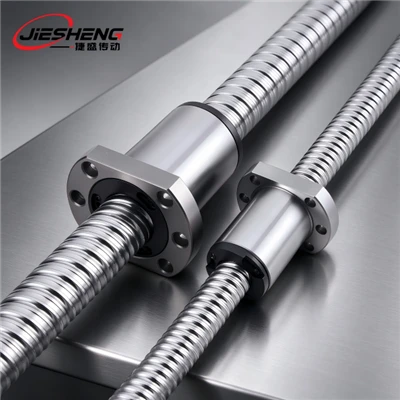
SFK Flanged Ball ScrewShrink the screw and the nut refuses to shrink with it. At Ø8 the body is 14 mm - the mounting face is still 27 mm across. SFK is the small-diameter flange series: same square mounting face everyone draws, scaled down until three things stop scaling - the ball, the nut wall and the bolt. That is why the flange ends up proportionally larger than the body it carries, and why a miniature axis is rarely as compact as the drawing promised.
 14 mm Body at Ø8 27 mm Flange Square 1.93 Flange / Body EK EF Supports
|
01 / Where the scaling stops
The Flange Ratio Climbs as the Screw Shrinks
Take the catalogue bodies and flanges across the range. The nut body halves when the shaft halves - the flange does not. Dividing flange across-flats by body diameter gives the real story: about 1.6 at Ø32 and Ø20, and close to 1.9 at Ø8 and Ø10.

Dimensions from published SFU and SFK catalogue tables, in millimetres. Flange across-flats is the A dimension; body is the D dimension. Two catalogues give slightly different bodies for SFK0801 - see the note at the catalogue section.
Flange across-flats, relative to body diameter

Shorter bar is a slimmer nut relative to its flange. The right-hand end of the range is where the design gets crowded.
 What the Ratio Costs You
A 27 mm square face on an Ø8 shaft means the bolt circle is nearly four times the shaft diameter. In machine terms, the nut no longer fits a slim cantilever or a compact slide - the flange, not the shaft, decides the envelope.
It also means the mounting face is stiffer than the shaft it drives. Bending and torsional deflection live in the screw, while the joint stays rigid, so alignment matters more than flange thickness.
02 / The part that works hardest
Every Ball Passes the Return Gate Once a Turn
SFK uses an internal deflector - the balls are picked up inside the nut wall and steered back a turn. Elegant, because nothing protrudes. Also demanding, because the gate is struck once per revolution per circuit, and a miniature screw turns far faster than a large one.

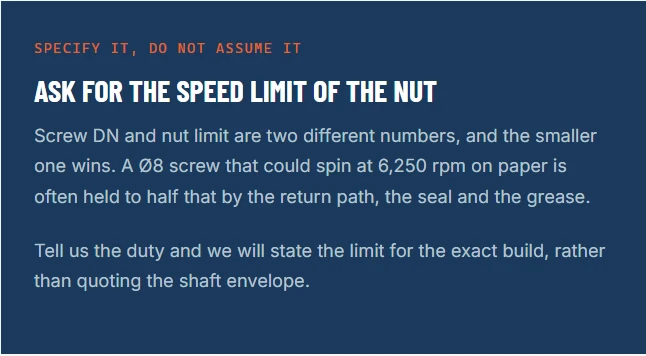
Gate events = (rpm / 60) × number of circuits. DN 50,000 is an envelope for the shaft; the nut may be the lower limit, and the catalogue must be read for the specific size. Linear speed uses the lead of that model.
Two Consequences Nobody Expects
Noise arrives before wear. A deflector struck 104 times a second is a tiny percussion instrument. Above roughly 3,000 rpm on a Ø8 screw, the dominant sound in a quiet machine is often the nut, not the motor.
Wear is local. The gate is the only place where a ball leaves the raceway, so it takes the impact that the raceway never sees. On a miniature axis run continuously at speed, the deflector - not the balls - is the part that sets life.
03 / Three floors nothing compressesWhy 27 mm Is the Floor, Not a Luxury
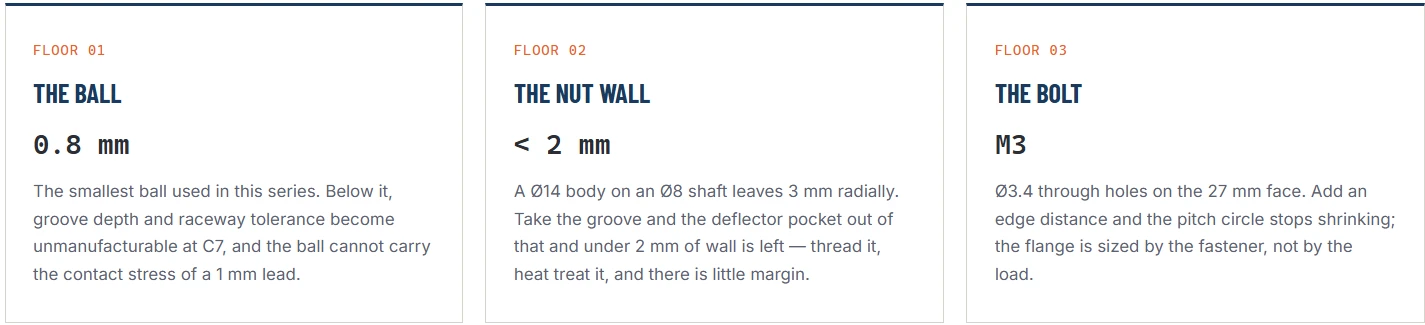
Every dimension on a flange nut is chained to three physical limits. None of them scale with the shaft, and each one sets a lower bound the designer cannot argue with.

04 / Catalogue build
Four Sizes, Transposed
The small series is short enough to read sideways. Rows are dimensions, columns are models - the opposite of how the big series is usually printed, because here the interesting comparison is between four models, not between twenty.


Dimensions in millimetres, values as printed in the published SFK catalogue table. A second catalogue lists SFK0801 as body 12 / flange 24 / length 15 with 1×3 turns and a rigidity of 9 kgf/µm - about 88 N/µm, against the 140 N/µm above. The model number matches, the numbers do not, so confirm the drawing before you cut a bracket. Support units for this series are the miniature EK (fixed) and EF (support) blocks; FK/FF round units also fit.
 Two Numbers to Compare, Not One
Capacity and stiffness do not fall at the same rate. At Ø8 the dynamic rating is 1,610 N against 8,610 N at Ø20 - about 5.3 times less. Stiffness is 140 against 390 N/µm - only 2.8 times less.
So a miniature screw is soft before it is weak: 100 N deflects it by 0.71 µm, where the Ø20 moves 0.26 µm. If your error budget is tight, the stiffness number matters first; if your load is heavy, the capacity number does.
05 / Applications
Where 27 mm on Ø8 Is Normal


06 / FAQ
What Buyers Ask About Small Flanges
Q: Is SFK just a small SFU?
A:No. SFU covers Ø12–32 with the standard square flange and BK/BF supports. SFK is the miniature branch: Ø6–14, internal deflector return, smaller bodies, EK/EF support blocks, and a mounting face that is proportionally larger than the body.
Treat them as two designs that share a catalogue, not one design at two scales.
Q: Why does the flange look oversized on a Ø8 nut?
A:Because it is, relative to the body. The flange has to carry M3 bolts with edge distance and a counterbore, and those dimensions do not shrink with the shaft.
The ratio is 1.93 at Ø8 against 1.61 at Ø20. If the bracket looks out of proportion to the shaft, the drawing is honest.
Q:How fast can the nut actually run?
A:Lower than the shaft DN figure. The internal deflector is struck once per turn, the seal adds drag, and the grease has a speed limit of its own. Ask for the limit of the specific build.
On a Ø8 with a 1 mm lead, 3,000 rpm already means 50 mm/s and 50 gate events per second - enough to be audible in a quiet machine.
Q: Can I get a left-hand or larger-lead version?
A:Left-hand threads are available on this series; the catalogue marks which models can be produced left-handed, and a plain shaft with a reversed nut is simpler than reversing the whole axis.
Larger leads exist within the small range - up to 4 mm on Ø10 - but capacity drops as the lead grows, since fewer balls carry the load per turn.
Q: Which support blocks go with it?
A:EK for the fixed side and EF for the floating side, both miniature rectangular types made for small screws. FK/FF round blocks fit as well if the frame is drilled for round.
Keep the pair from one source: mixed blocks arrive at different heights, and a 0.01 mm height error already bends a Ø8 shaft.
Q:What information do you need to quote?
A: Stroke, load, the mounting face you have room for, and the speed or duty cycle. The face dimension decides whether SFK fits at all - a 27 mm square is a commitment before any other number matters.
Send the bracket drawing if you have one; we will confirm the hole pattern against the catalogue before quoting.

Send the Face You Can Spare
Bracket space, stroke, load and speed. On a miniature axis the mounting face is the first constraint, not the last - tell us what fits and we will tell you which model survives it.
Hot Tags: sfk flanged ball screw, China sfk flanged ball screw manufacturers, suppliers, factory, ball screws for different end configurations testing, ball screws for inclined applications, ball screws for semiconductor equipment, ball screws for vertical applications, ball screws for water treatment plants, CNC Milling Machine Ball Screws