|
| Cold Rolled Series · Formed, Not Cut
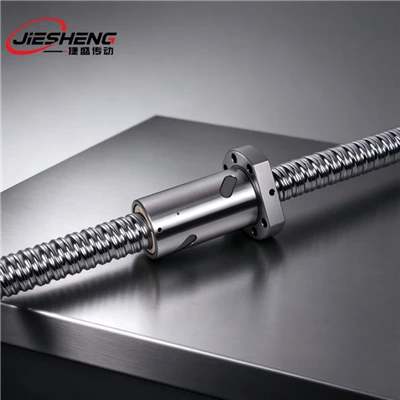
Cold Rolled Ball ScrewThe thread is squeezed into the steel, so its accuracy is decided by a die - before the thread exists. Rolling gives you a fast, inexpensive screw with a grain structure a grinding wheel cannot produce. It also removes your ability to correct anything afterwards: once the die has run, the class is fixed at C7.
C7 Standard Class ±0.05 mm / 300 mm Ø12–50 Shaft Range 2–3 Weeks, Stock Sizes
|

01 / The process
A cold rolled screw starts as a turned blank. Two hardened dies then press into the blank at room temperature and the steel flows into the groove - nothing is cut away. The grain follows the thread profile rather than being severed by it, which is why a rolled groove has no interrupted fibres at the root.
That is also why the accuracy cannot be adjusted later. On a ground screw the last pass removes a few microns and the class is dialled in. On a rolled screw the die is the last operation that touches the groove: whatever it produced is what you get, and the only correction available afterwards is grinding - which turns the part into a ground screw and puts you back at ground cost and lead time.
The route is short, and every step after rolling exists to protect what the roll produced rather than to improve it:


02 / Specifications
Cold Rolled Range
|
Process
|
Cold thread rolling from a turned blank; no material removed at the groove |
|
Shaft diameters
|
Ø12 / Ø16 / Ø20 / Ø25 / Ø32 / Ø40 / Ø50 mm |
|
Standard leads
|
4 / 5 / 10 / 16 / 20 mm - other leads require new tooling |
|
Accuracy class
|
C7 standard ±0.05 mm / 300 mm; C10 available for looser duties |
|
Shaft material
|
GCr15 chrome bearing steel (SUJ2 / SAE 52100 equivalent), hardened HRC 58–62 |
|
Surface
|
Formed, matte; not ground. Surface roughness is not to grinding standards by design |
|
Nut options
|
Single nut standard; preloaded < 0.02 mm backlash or double nut < 0.01 mm |
|
Lengths
|
To 3,000 mm; accumulated lead error stated on the inspection report |
|
End machining
|
Journals, keyways and threaded ends machined after rolling, to drawing |
|
Straightness
|
Straightened after heat treatment to the agreed figure; check the report, not the catalogue |
|
Load rating
|
Size-specific - request the datasheet for the exact diameter and lead |
|
MOQ / lead time
|
2–5 pcs; 2–3 weeks for stock diameters and leads, longer for new tooling |
* A rolled screw is specified by diameter, lead, class and length - in that order. Anything beyond the die's standard combination is a tooling decision, and we will tell you before quoting rather than after.
03 / Where rolling stops
Four Things a Rolled Screw Cannot Do
It Cannot Be Corrected
There is no finishing pass. If the lead lands outside the class, the shaft is re-rolled only by removing material and starting again - in practice, it is scrapped or downgraded.
It Cannot Reach C5 by Rolling
C5 at ±0.018 mm/300 mm is a grinding class. A "C5 rolled" screw is a rolled blank whose thread was then ground - price and lead time follow the grinding, not the rolling.
It Cannot Stop Mid-Shaft
The die has to run off the end of the thread. Where a thread must terminate against a shoulder, specify a runout groove and let us confirm the geometry before the blank is cut.
It Cannot Be Re-Leaded Cheaply
Lead and diameter come from the die. A non-standard combination means new tooling, which is why stock sizes are fast and a custom lead is neither fast nor cheap.


Classes follow JIS B 1192 practice as used across the SFU range. Actual delivered tolerance is stated on the inspection report for your order, including the accumulated figure over the full thread length.
04 / Applications
Where a Rolled Screw Is the Correct Choice
Woodworking Machines
Dust, long strokes, tolerant positioning
Packaging Lines
Repeat moves, C7 is ample
Material Handling
Transfers and pushers
General Automation
Pick, place, index
Storage & Retrieval
Long travel, low precision need
Textile & Printing
Continuous motion
Food Processing
Washdown-tolerant designs
Test Stands
Adjustment axes, not metrology

05 / Ask for the right thing
What to Specify, What Not to Ask

06 / FAQ
Questions That Come With Rolling
Q: Is a rolled screw worse than a ground screw?
A: Not in every respect, and that is what makes the decision awkward. Rolling is worse on class: C7 against C5, and no correction pass to improve it. It is better on cost, on lead time, and on one specific failure mode - a ground groove can suffer grinding burn, and a rolled one cannot, because no wheel touches it.
So the question is not which is better, but which error your machine can live with. If the axis is positioned against a scale or a hard stop, C7 rolled is often fine. If the screw itself defines the position, grinding is the answer.
Q: Can I buy a C5 rolled ball screw?
A:Not from rolling alone. C5 at ±0.018 mm/300 mm is reached by grinding the thread - sometimes on a blank that was first rolled. That is a legitimate route and it saves material, but it is a ground screw commercially: the price and the lead time follow the grinding.
Ask which route the supplier used. "Rolled C5" without a grinding step usually means the class was copied from a datasheet rather than measured.
Q:Why is my 2 m screw further out than 0.05 mm?
A:Because the class is defined per 300 mm, not over the whole screw. Each 300 mm slice can be inside tolerance while the accumulated error from end to end is several times larger. Leading screws accumulate; the tolerance does not reset every 300 mm.
Three ways out: accept the larger error, map the lead by measuring and compensate in the controller, or move the thread to grinding. For a long machine that must hold position, the map is usually cheaper than the C5 screw.
Q: Can the thread end against a shoulder?
A: Only with a runout groove. The die has to roll off the end of the thread, so a thread that must stop against a square shoulder needs a relief groove at that point for the die to run into. Without it, the last few threads are incomplete and the nut cannot reach the shoulder.
Send the drawing before the blank is cut - changing this after rolling means starting a new shaft.
Q: Does rolling make the screw stronger?
A:It changes the structure: the grain flows along the groove instead of being cut through it, so there are no interrupted fibres at the root where fatigue cracks begin. That part is genuinely different from grinding.
But be careful with the fatigue story. Cold working also leaves compressive stress, and if the shaft is subsequently hardened to HRC 58–62, much of that stress is relieved by the heat cycle. We would not choose a screw on that claim alone.
Q:Why is a rolled screw cheaper and faster?
A:One forming pass replaces the sequence of grinding passes a ground thread needs, and no specialist grinding time is consumed. When the die already exists for your diameter and lead, the part is essentially blank preparation, rolling, heat treat, straighten and end machining.
The saving disappears the moment your lead needs a new die: tooling has to be made and amortised, and that is a decision about volume, not about process.

Send the Drawing Before the Blank Is Cut
Diameter, lead, length, and where the thread terminates. On a rolled screw those four answers are fixed at the die, and changing them afterwards means a new shaft.
Hot Tags: cold rolled ball screw, China cold rolled ball screw manufacturers, suppliers, factory, ball screws for deformation testing, ball screws for lathes, ball screws for medium sized enterprises, ball screws for semiconductor equipment, ball screws with flange mounts, Custom CNC Machine Ball Screws