|
| Single Nut Series · One Body, One Ball Train
Single Nut Ball ScrewIt saves a nut's length and a spacer - and it takes away your ability to re-set the preload later. If the nut is preloaded, that preload is fixed by the balls at assembly. When the contact wears, the preload quietly leaves with it, and there is no shim to turn. This page is about what that commitment buys and what it costs.
<0.05 mm Standard Backlash <0.02 mm Preloaded 2–10% of Ca, Preload Ø16–50 Shaft Range
|

01 /What a single nut is
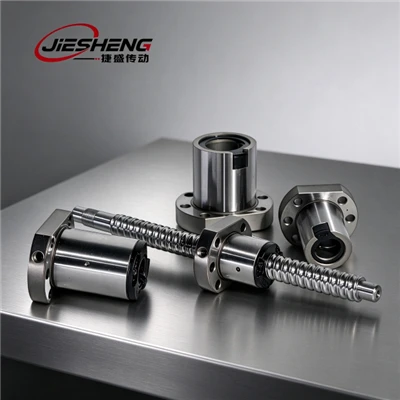
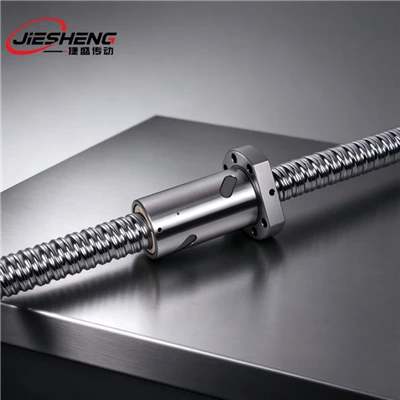
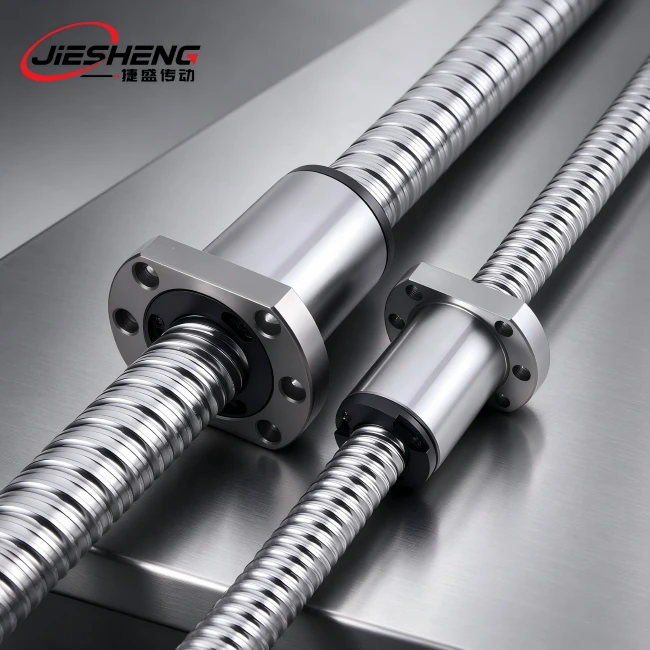
A single nut is exactly what the name says: one nut body on the shaft, one ball train inside it, one flange to bolt to the carriage. There is no second nut and no spacer ring, so the nut occupies its own length and nothing more.
It has to do two jobs at once - carry the axial load and hold the position without slack. A double nut solves this by splitting the work: the two nuts push against each other through a shimmed spacer, and that opposing force is the preload. A single nut has no second body to push against, so it manufactures the same effect differently: slightly oversized balls are loaded into the race, and the interference between ball and groove becomes the preload.
That difference is the whole story. A shimmed double nut can be re-set - add a thinner shim, restore the preload, compensate for years of wear. An oversized-ball single nut is set once, at assembly, and cannot be adjusted afterwards, because the preload is not a setting: it is a dimension.


02 / Specifications
Single Nut Range
|
Nut type
|
Single flange nut, SFU standard; cylindrical single nut on request |
|
Reference size Ø20 / 5 mm
|
Body Ø36 · flange 58 · flange thickness 10 · length 42 · 6×M6 on 47 PCD |
|
Inside the reference nut
|
3.175 mm balls · 1×3 turns · internal return · Ca 8.6 kN · C₀a 17.1 kN |
|
Backlash, standard
|
< 0.05 mm single nut, no preload |
|
Backlash, preloaded
|
< 0.02 mm by oversized-ball selection, set at assembly |
|
Preload range
|
2–10% of Ca; values above 10% quoted only after a drag and life review |
|
Material
|
GCr15 chrome bearing steel, hardened HRC 58–62; balls GCr15 |
|
Seals
|
Optional double-lip seals; adds drag torque, protects grease fill in dusty duty |
|
Lubrication
|
Grease standard; oil where duty cycle is high and heat must be carried away |
|
Mounting
|
Flange bolted to carriage, or cylindrical body clamped in a housing |
|
Matching
|
Nut and screw supplied as a set; the ball selection is made for that screw's groove |
|
MOQ / lead time
|
2–5 pcs; 2–3 weeks for stock sizes |
* Catalogue figures, given for the Ø20 / 5 mm reference size; other diameters and turn counts differ and are quoted per order. Backlash and drag torque are measured on the delivered set, not assumed from the class.
03 / Where the load actually goes
A Nut Is Not One Contact
Buyers read "Ca 8.6 kN" as a property of the nut. It is really a property of a few dozen ball contacts working in parallel. Counting them changes how you think about load, stiffness and wear.

Geometry from the Ø20 / 5 mm size: root Ø17.9 mm plus one ball diameter gives the ball centre circle; count = circumference divided by ball diameter. The half-loaded assumption is an orientation estimate, not a catalogue figure.

04 /Applications
Where the Single Nut Wins
Compact Carriages
No room for a spacer
Short-Stroke Axes
Nut length is the constraint
OEM Volume
Set-and-forget assembly
One-Direction Thrust
Backlash never reverses
Vertical Light Loads
With a brake, not on it

Semiconductor Handling
Short travel, clean duty
Lab & Test Rigs
Adjustment axes
Retrofit Kits
Drop-in for worn nuts

05 / The maths of preload
Stiffness Rises With a Cube Root
Ball-to-groove contact is a Hertzian contact, and its deflection grows with load to the power of two thirds. Invert that and you get the rule that governs every preload decision: stiffness rises with the cube root of preload. Drag torque, meanwhile, rises in direct proportion. The two curves separate fast.

Index relative to a 2% light-preload nut. Stiffness index = (Fp₂/Fp₁)⅓; drag index = Fp₂/Fp₁. Force column calculated from Ca 8.6 kN, the catalogue value for the Ø20 / 5 mm size.

06 / The decision
Three Ways to Buy the Same Screw

Lengths shown for the Ø20 / 5 mm size. A spacer and a second nut typically add one nut length or more to the assembly.
 The Length You Save Is the Length You Cannot Adjust
On a carriage that is already tight, or on a short-stroke axis where the second nut will not fit, the single nut is not a compromise - it is the only option that closes.
On an axis that will run for ten years and be re-preloaded twice, the double nut is the cheaper purchase in total, because you are buying the ability to restore preload instead of replacing a nut.
07 / FAQ
The Questions Buyers Ask About One Nut
Q: Is a single nut enough, or do I need a double nut?
A:It depends on what you are asking the nut to do over time, not on the load. If the axis pushes in one direction, or if the position is closed by an external reference, a standard single nut is enough and costs the least.
If the axis reverses and the screw defines the position, you need preload - and then the question becomes whether you will ever need to restore it. On a machine that will be serviced for a decade, a shimmed double nut is usually the cheaper choice overall.
Q: Can a single nut be preloaded?
A:Yes, by oversized balls: the balls are selected slightly larger than the groove would take freely, and the resulting interference is the preload. Backlash drops from 0.05 mm to 0.02 mm or better.
What you cannot do is adjust it afterwards. There is no shim, no set screw, no second nut. Changing the preload means re-balling the nut.
Q:Which preload should I specify?
A:Start at 2–5% of Ca for a general reversing axis and go to 10% only if you have measured that you need it. The reason is the cube root: from 2% to 16% - eight times the preload - stiffness only doubles, while drag rises eightfold.
If you find yourself specifying 20% or more, the honest answer is usually a bigger screw or a double nut, not a harder preload.
Q: Will the preload disappear in service?
A:It will decrease, and it will not come back. Every hour of running polishes the groove and the balls slightly; the interference that created the preload reduces with that wear. A preloaded single nut therefore has a preload life, not a permanent setting.
Watch the drag torque. When it starts falling, preload is leaving. That reading is the only early indicator you will get.
Q: Does preload shorten the life of the nut?
A:It raises the standing contact stress, so yes, the fatigue margin shrinks as preload rises - the same eightfold preload that doubles stiffness multiplies the standing stress on every contact. Basic rating life falls roughly with the cube of the load, so a higher preload costs life faster than it buys stiffness.
The compensating benefit is that balls stay in contact through reversals, so the axis does not suffer impact loading across a backlash gap. On a reversing axis that is often worth the trade; on a one-direction axis it is pure cost.
Q:Can I convert a standard single nut to preloaded later?
A:Only by re-balling it with a larger ball set, and only if the nut is serviceable and the grooves are still in good condition. In practice most conversions are a replacement, not an upgrade.
If you expect to want preload later, buy the preloaded nut now, or buy a double nut and leave the spacer out until you need it - that is the cheapest option to keep open.

Tell Us the Duty, Not Just the Size
Direction of thrust, reversal frequency, and how long the machine will run between services. Those three decide single or double faster than any load number.
Hot Tags: single nut ball screw, China single nut ball screw manufacturers, suppliers, factory, ball screws for accessories, ball screws for quality control, ball screws for testing machines, ball screws for wastewater treatment equipment, ball screws with anti backlash features, High Precision Ball Screws