

Linear guide auto-centering characteristics of in-depth analysis
I. Definition and core role of auto-centering characteristics
Definition:
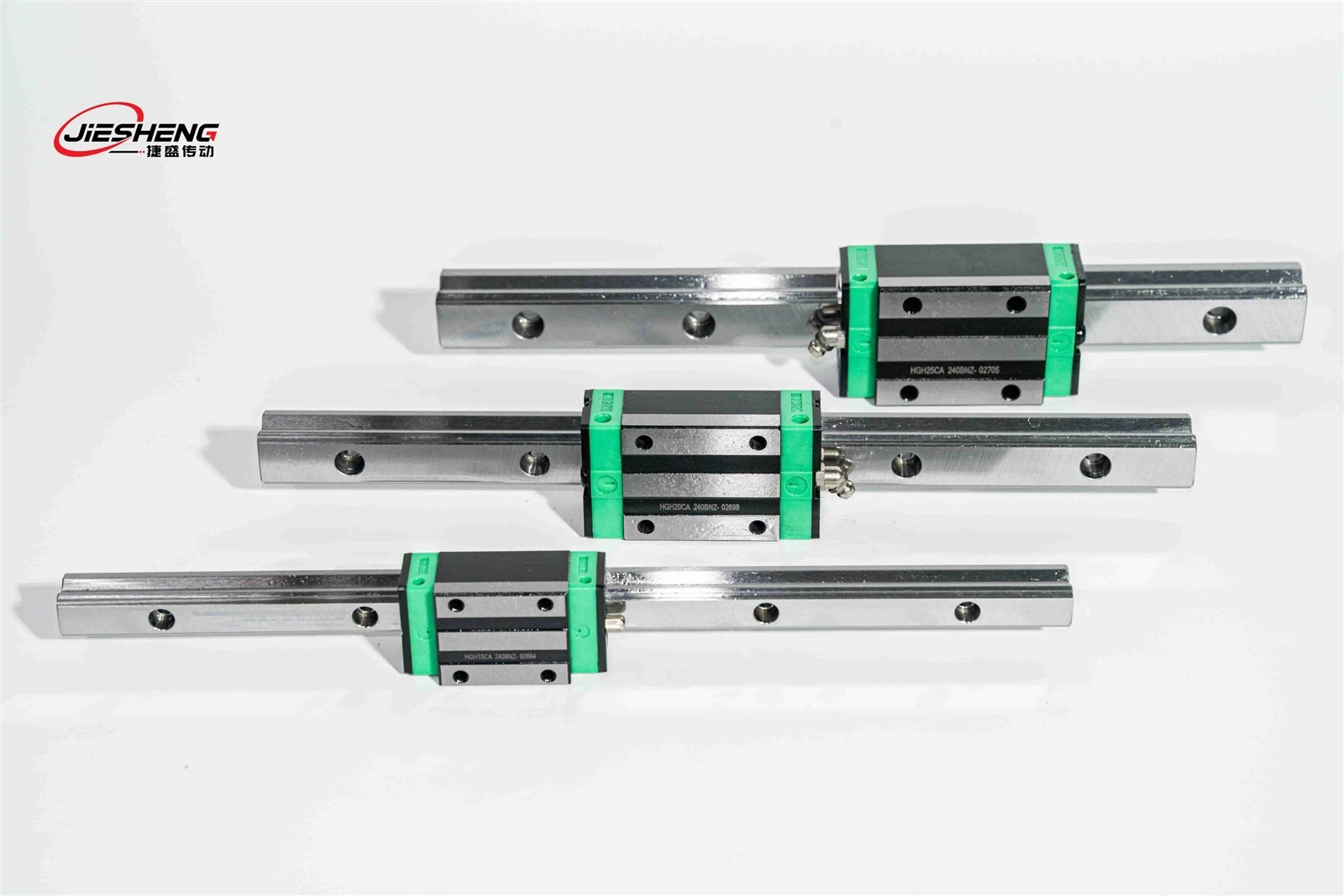
The auto-centering characteristics of linear guide refers to the ability of the slider to keep the center of the slider aligned with the centerline of the guideway automatically through the structural design when the slider is running on the guideway. Even if there is installation error or external lateral force, the guideway can offset the offset through elastic deformation or mechanical balance to maintain motion accuracy.
Core function:
Compensate installation error: if the deviation of guideway parallelism is ≤0.03mm, auto-centering can reduce the skew of the slider;
Equalize the load distribution: avoid overloading of one side of the ball, prolonging the life of the guideway;
Enhance the smoothness of the movement: eliminating the vibration or stuttering due to the deviation, which is suitable for precision machining scenarios.
The four key influencing factors of auto-centering
1. Guideway cross-section structure design
Symmetrical cross-section:
Double-row ball guide (e.g. HIWIN HG series) makes lateral forces cancel each other by the symmetrical layout of the upper, lower, left and right raceways. For example, when the slider is subjected to a force to the left, the right ball squeezes the raceway to create a reverse spring force that pushes the slider back to center.
V-groove and rectangular groove differences:
V-type guide (such as THK SR series) using the wedge effect of the V-shaped surface, the slider will be offset due to the oblique reaction force automatically back to the right, the centering ability is stronger than the rectangular guide, but the frictional resistance is slightly larger. 2.
2. Ball arrangement and preload
Number and spacing of ball rows:
Four rows of ball guide (such as INA Linear Module) through the front and back of the symmetrical distribution of the right and left to form a three-dimensional centering support. An experimental data shows that the centering error of a four-row guideway is 60% lower than that of a two-row guideway.
Principle of moderate preload:
If the preload is too high, the elastic deformation will be inhibited and the centering ability will be lost; if it is too low, the slider will shake. Ideal preload for the rated load of 10% -15%, this time the slider in the force can be achieved through a slight displacement of the ball to achieve automatic centering.
3. Material Elasticity and Structural Stiffness
The raceway material (e.g., GCr15 bearing steel) needs to be moderately elastic: when the slider deflects, the raceway surface deforms slightly to generate a return force, similar to a spring reset mechanism. A guide because of the use of quenched hardness HRC60 raceway, centering response time <0.1ms.
Insufficient rigidity of the slider body will lead to centering failure: for example, aluminum alloy slider deformation under heavy loads, can not be returned to the right through the elastic force, the need to use cast iron or high-strength steel materials.
4. External loads and guiding accuracy
Balance of radial loads and axial loads: when the axial force (e.g. table deflection) exceeds 30% of the radial force, the centering ability decreases. A machining center has a 40% increase in slide offset due to excessive axial force caused by workpiece offset.
The influence of the guide length: long slider (guide length > 200mm) due to more support points, centering stability is better than the short slider, suitable for large stroke equipment.
The working principle of automatic centering and typical scenes
▶ Schematic diagram of the working principle
Offset occurs: the slider is offset to the right by the lateral force F Δx;
Elastic deformation: the right side of the ball squeezes the raceway, generating the reverse elasticity F';
Moment balance: F'×L (force arm) and F×L offset, pushing the slider back to the center, and the Δx reduces to ≤ 0.005mm.
▶ Practical application scenarios
Installation Error Compensation: The parallelism of a guideway of a NC machine tool has a 0.02mm deviation, and the parallelism of the guideway has a 0.02mm deviation. The parallelism of the guideway of a CNC machine tool has a deviation of 0.02mm. Relying on the auto-centering feature, the deviation of the slider is controlled within 0.003mm, which does not affect the machining accuracy.
Dynamic Load Adjustment: Lateral force is generated by tool vibration during high-speed cutting, and automatic centering keeps the slider moving in a straight line, thus reducing the surface roughness Ra from 1.6μm to 0.8μm on a vertical machining center.
Fourth, the design and selection of centering capacity optimization strategy
structure selection recommendations:
high-precision scenarios choose four rows of ball + V-groove guideway (such as THK V1 series), centering error ≤ 0.002mm;
heavy-duty scenarios choose double rows of roller guideway (such as SKF LIN rail), through the characteristics of the large contact area of the rollers to improve the stability of centering.
Installation and debugging points:
preload calibration: use torque wrenches to tighten the guide rail according to the specified value (such as M8 bolt torque 12N・m), to avoid uneven preload to destroy the centering equilibrium;
guide datum processing: the roughness of the mounting surface Ra ≤ 1.6μm, flatness ≤ 0.01mm/100mm, to provide the basis for the automatic centering conditions.
Maintenance and fault prevention:
Regular testing of centering accuracy: use micrometer to move the slider along the guideway, record the offset, check the preload or wear of the raceway when it exceeds 0.01mm;
Avoid unilateral loading: try to center the workpiece when installing, a lathe due to the offset of the workpiece leads to the wear of one side of the guideway, the centering capacity decreased by 30%, and the centering capacity returned to normal after adjustment.
V. Limitations and breakthrough direction of automatic centering characteristics
Limitations:
When the installation error > 0.05mm or load impact > 2 times the rated value, automatic centering fails. For example, because a stamping machine is not installed buffer device, the instantaneous impact caused by the slider offset can not be corrected, the risk of ball falling off increased.
Technological breakthrough:
new magnetic levitation guide (such as Yaskawa magnetic levitation guide) through the electromagnetic force to actively adjust the position of the slider, breaking through the mechanical structure of the limitations of the centering accuracy of up to 0.001mm, suitable for semiconductor lithography and other ultra-precision equipment.

Summarize: automatic centering of the "three-dimensional balance" principle
structural balance: symmetrical raceway + a reasonable number of ball columns, to build a mechanically symmetrical system;
rigidity balance: the elasticity of the raceway and the rigidity of the slider to match, to avoid "over-rigid instability" or "over-soft offset"; stiffness balance: the elasticity of the raceway and the rigidity of the slider to match, to avoid "over-rigid instability" or " Rigidity balance: matching the elasticity of the raceway with the rigidity of the slider to avoid "over-rigid instability" or "over-soft offset";
Load balance: controlling the proportion of axial force to ensure the centering response speed and accuracy.
Through the above strategies, the auto-centering error of linear guide can be controlled at micron level to meet the demanding needs of high-end manufacturing for motion accuracy.
Contact Us
📞 Phone: +86-8613116375959
📧 Email: 741097243@qq.com
🌐 Official website: https://www.automation-js.com/


