

What are the main components of a CNC ball screw?
Hey! Many CNC equipment engineers and machine tool maintenance personnel often encounter this confusion when dealing with CNC ball screws: "Why do some ball screws maintain stable precision for years, while others develop backlash or abnormal noises after just a short time? Is it enough for the screw body to be sufficiently rigid?" Some believe that "the core of a CNC ball screw is just the screw and nut, with other components being insignificant," overlooking how critical elements like rolling elements and preloaders impact precision and lifespan. Others assume that "any combination of parts will function adequately," failing to recognize that component compatibility directly affects transmission efficiency. Still others have vague understandings of component functions, leading to misdiagnosed faults during maintenance and delayed equipment recovery times. In reality, CNC ball screws are transmission systems where multiple precision components work in concert, each playing an irreplaceable role. For instance, if rolling element precision deviations exceed 0.001mm, it causes periodic vibration during screw operation. Preload device failure directly leads to transmission backlash, compromising positioning accuracy in CNC equipment. Today, we'll systematically explore the core components of CNC ball screws, their functions and technical requirements, the compatibility logic between parts, and key maintenance points. This will help you fully grasp the characteristics of CNC ball screw components, providing a reference for equipment selection, repair, and maintenance.

First, Understand: The 2 Core Characteristics of CNC Ball Screw Components-It's Not Just About "Having Them All"
As the "core transmission unit" for CNC equipment (e.g., machining centers, CNC lathes), CNC ball screws require component designs centered on "high-precision transmission" and "long-term stability." These two characteristics dictate that the technical standards for each component far exceed those of ordinary ball screws, forming the foundation for understanding their functions.
Feature 1: High Load Tolerance - Components Must Be "Wear-Resistant and Fatigue-Resistant"
During machining, ball screws endure axial loads, radial off-center loads, and periodic impacts. All components require sufficient strength and durability:
Material Strength Requirements: Core components must use high-strength materials with rigorous heat treatment to ensure wear resistance.
Fatigue-Resistant Design: Component structures must optimize fatigue stress distribution; Lubrication Compatibility: All components must align with the CNC machine's lubrication methods.
Second, the 6 Core Components of CNC Ball Screws: Function, Technical Requirements, and Operational Logic
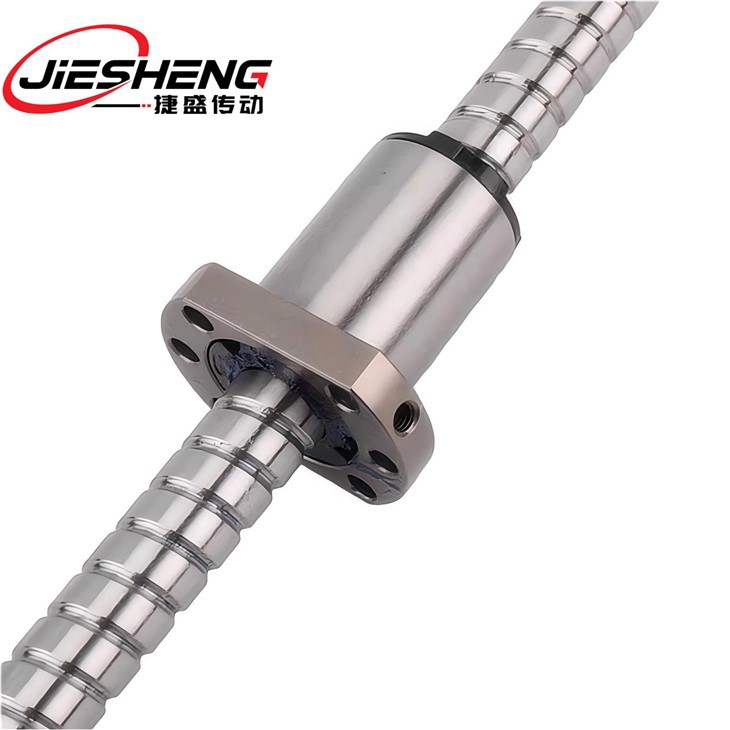
The transmission function of CNC ball screws is achieved through the coordinated operation of six core components: "screw shaft, nut, rolling elements, recirculation system, preload device, and protective device." Each component has a distinct functional role and must meet stringent technical standards, with none being dispensable.
1. Component 1: Screw Shaft - The "Core Carrier" of Transmission
The screw shaft is the core component for transmitting motion and power. Through its precision-ground raceway interacting with rolling elements, it converts rotational motion into linear motion:
Core Functions:
- Withstands axial loads, converting the motor's rotational torque into linear thrust (or pull);
- Ensures transmission accuracy by precisely controlling linear displacement via lead control;
Structural Details: Both ends of the lead screw require machined journals (for bearing installation). The coaxiality between the journals and the lead screw body must be ≤0.001mm to prevent radial runout after installation. For long lead screws (e.g., length >2m), intermediate support structures must be designed to prevent bending deformation during high-speed rotation.
2. Component 2: Nut - The "Constraint and Guidance Unit" for Rolling Elements
The nut interacts with rolling elements and the lead screw via its internal raceway, constraining the rolling elements' trajectory while converting their rotational motion into linear motion:
Core Functions:
Accommodates rolling elements and guides their cyclic motion through the raceway;
Achieves precise transmission with the lead screw, ensuring smoothness and accuracy of linear motion;
Technical Requirements:
Material & Machining: Select SUJ2 steel or copper alloy. Nut body requires precision machining with raceway dimensional tolerance of ±0.001mm and clearance between nut raceway and lead screw raceway ≤0.0005mm;
Geometric Tolerances: Perpendicularity between nut bore and flange end face ≤0.001mm (C5 grade) to prevent misalignment with screw axis after installation, avoiding operational jamming; Positioning accuracy of flange mounting holes ≤0.002mm to ensure connection precision with CNC machine tool tables;
Heat Dissipation Design: Nuts operating in high-speed scenarios (e.g., screw rotation speed > 3000 r/min) require integrated cooling structures or hollow nut designs (with internal cooling channels) to prevent friction-induced deformation of the raceway, which could compromise precision.
3. Component 3: Rolling Elements - The "Motion Transfer Medium" of Transmission
Rolling elements (typically steel balls or rollers) serve as the "bridge" between the lead screw and nut. They replace sliding friction with rolling friction, reducing transmission resistance and enhancing efficiency:
Core Functions:
- Reduce frictional resistance (rolling friction coefficient approx. 0.001–0.005, significantly lower than sliding friction's 0.1–0.3);
Quantity and Arrangement: Determine the number of rolling elements based on load requirements. Adopt either "crossed arrangement" or "equidistant arrangement" to ensure uniform load distribution and prevent individual rolling elements from overloading and failing.
4. Component 4: Circulation Device - The "Circulation Channel" for Rolling Elements
The circulation device guides rolling elements in continuous motion between the screw and nut raceways, preventing them from falling off either end and ensuring uninterrupted transmission:
Core Functions:
Provides a circulation path for rolling elements, enabling "endless" transmission;
Minimizes collisions and wear during circulation, ensuring smooth motion;
Technical Requirements:
Structure Types: Common designs include "tube-insert type" (connecting nut end raceways via metal/plastic tubes, suitable for medium/small lead screws), "end-cap type" (installing end caps with internal circulation grooves on nut ends, suitable for large lead screws), and "internal circulation type" (machining circulation channels within the nut without external components, suitable for high-speed applications);
Material and Precision: Circulation device materials must be compatible with rolling elements. Circulation channel dimensional tolerance: ±0.002mm. Channel surface roughness: Ra ≤ 0.2μm to prevent stalling during rolling element passage.
Smoothness
Design: Circulation channel inlets and outlets require curved transitions (radius ≥0.5mm) to minimize impact on rolling elements. Internal circulation devices must incorporate lubrication grooves within the circulation channel to ensure continuous lubrication during rolling element circulation.
Third, the Three Core Matching Logics and Maintenance Essentials for CNC Ball Screw Components
Components do not operate independently but must collaborate according to the logic of "precision matching, load matching, and operating condition matching." Simultaneously, scientific maintenance is essential to ensure long-term stable performance.
1. Component Matching Logic: Three "Matches" Ensure Overall Performance
Precision Matching: All components must share consistent precision grades to prevent downgrading caused by pairing high-grade screws with low-grade nuts.
Load Matching: Rolling element count, screw diameter, and nut structure must align with load requirements to avoid component overload.
Operating Condition Matching: Select components based on CNC equipment speed, ambient temperature, and contaminant types. High-temperature scenarios (temperature >80°C) require high-temperature grease and stainless steel protective covers. For high-chip environments, use steel plate guards + chip scrapers.
2. Component Maintenance Essentials: 4 "Regular" Practices to Extend Lifespan
Regular Lubrication: Determine lubrication intervals based on operating conditions. Use specialized CNC ball screw grease, controlling the amount (typically 1/3–1/2 of the nut's internal space) to prevent overheating or waste from excess lubrication;
If preload decreases, adjust shim thickness or replace the preload device to prevent backlash.
Summary
The performance of CNC ball screws relies on the coordinated operation of six core components: "lead screw, nut, rolling elements, recirculation system, preload device, and protective device." Each component has a distinct functional role and stringent technical standards:
- The lead screw serves as the transmission medium, requiring high-precision lead and high strength.
Contact Us
📞 Phone: +86-8613116375959
📧 Email: 741097243@qq.com
🌐 Official website: https://www.automation-js.com/


