

Home - Precision Machinery Blog - A Practical Guide to Selecting Ball Screw Supports
In applications such as CNC machine tools, automated equipment, precision slides, and industrial robots, Ball Screw Supports may appear to be merely auxiliary structural components, but they are actually critical parts that ensure transmission accuracy, suppress screw vibration, and extend the service life of the screw. Though structurally simple, it secures the lead screw in position, withstands radial and axial loads, compensates for thermal expansion, and provides dust-proof sealing and vibration damping-making it the "positioning and support guardian" of precision transmission systems. Many users, unfamiliar with its characteristics and models, make uninformed selections that lead to equipment vibration, reduced accuracy, and lead screw damage, thereby increasing debugging and downtime costs.
|
|
Key Points of Ball Screw Supports
Ball Screw Supports are precision components installed at both ends of a ball screw to support, position, and secure it. As fundamental accessories in transmission systems, their core function is to assist in the stable operation of the ball screw. Their key features are clear and easy to understand; mastering these points allows for quick differentiation between various mount types to meet daily selection and usage needs:
Clear functional positioning and significant support performance. Ball screw supports do not directly participate in power transmission; their core functions are "positioning support + load bearing + error compensation." They can fix the screw axis, reduce radial runout, withstand radial and axial forces during operation, compensate for thermal expansion of the screw, and accommodate ball screws of various specifications.
Standardized structure and comprehensive model system. Ball screw brackets feature universal models with standardized dimensions and high interchangeability. They can be directly matched with mainstream ball screws without customization, facilitating design, replacement, and maintenance.
Built-in precision bearings ensure both rigidity and accuracy. As the core functional support of the bracket, they come standard with angular contact ball bearings or deep groove ball bearings, allowing flexible adaptation to specific application requirements; For demanding applications involving high speeds, heavy loads, and high precision, high-rigidity models utilize matched bearing sets that undergo precision preloading. This ensures smooth, jamming-free operation while providing ample support rigidity, effectively preventing precision loss during transmission and perfectly meeting the precision transmission requirements of ball screws.
Integrated sealing structures ensure strong environmental adaptability. To address the complex operating conditions of industrial environments, most brackets are equipped with basic sealing components such as oil seals and dust covers. High-end models feature an upgraded design combining double oil seals with labyrinth-style dust protection, effectively blocking the ingress of external contaminants-such as dust, cutting fluid, and moisture-into the internal bearings. This prevents issues like wear and corrosion, significantly enhancing the bracket's adaptability and service life in complex environments such as workshops and automated production lines.
Simple installation and high versatility. All brackets adopt a unified flange or base-mounted design, with mounting holes strictly adhering to standardized specifications. This eliminates the need for complex machining or debugging processes, allowing even novices to quickly complete assembly. Additionally, the disassembly process is straightforward; subsequent equipment maintenance or bearing replacement does not require dismantling the entire drive system, effectively improving maintenance efficiency and further highlighting their practical advantages as standardized components.
Moderate cost with outstanding value for money. As a standardized precision component, its price is significantly lower than that of a ball screw, yet it has a major impact on equipment precision and stability. A small investment can improve transmission quality and reduce failures, making it a key component that exemplifies the principle of "small part, big impact."
Core Operating Principles of Ball Screw Supports
The operating principle of ball screw supports is straightforward. At its core, it employs a combination of "rigid support + bearing guidance + sealing protection" to address issues such as runout, wobble, uneven force distribution, and thermal expansion-induced jamming during screw operation. This enables the screw to achieve smooth, high-precision transmission. Specifically, the process can be divided into three key stages:
First, stable positioning and guidance to prevent operational deviations. When a ball screw rotates at high speeds, factors such as its own rigidity and load variations can cause radial oscillation and axial misalignment, which directly compromise the equipment's positioning accuracy and transmission stability. The ball screw support, through the tight fit between its high-precision bore and the built-in bearings, provides effective positioning at the screw shaft end, precisely fixing the screw's axis. This ensures the screw maintains coaxial, uniform rotation at all times, effectively suppressing oscillation amplitude and operational noise, and providing a solid foundation for high-precision transmission in the equipment.
Secondly, they absorb load forces to prevent component wear. When the ball screw drives a load in reciprocating or rotational motion, both radial and axial forces are generated simultaneously. If these forces act directly on the motor output shaft or the ball screw nut, they will rapidly accelerate component wear and may even cause deformation, damage, or other failures, affecting the normal operation of the transmission system. The precision bearings built into the bracket efficiently absorb these loads, distributing them evenly and transferring them to the equipment's mounting base. This effectively prevents bending and damage to the lead screw caused by localized stress concentration, extending the service life of the lead screw and surrounding core components while ensuring the continuous and stable operation of the transmission system.
Third, measures must be taken to address thermal expansion and contraction to prevent operational failures. During prolonged high-speed operation, the friction between the bearings and the lead screw generates continuous heat, causing the lead screw to heat up and expand axially. If both ends of the lead screw are rigidly locked in place using fixed-end brackets, the expanded screw will be forcibly constrained. This not only causes operational jamming and abnormal noises but, in severe cases, can lead to critical failures such as screw bending and bearing burnout. By adopting a floating-type structure for the support brackets, the system can flexibly accommodate the thermal expansion of the lead screw, automatically compensating for thermal expansion and contraction. This ensures the lead screw maintains smooth operation at all times, fundamentally preventing such failures.
Finally, proper sealing and protection are essential for maintaining stable precision. The dust seals and oil seals integrated into the mount serve as a critical protective barrier for long-term, stable operation. They effectively block external contaminants such as dust, coolant, and moisture, preventing these impurities from entering the bearing and lead screw interface within the mount. This protective function effectively prevents issues such as bearing wear, grease failure, and loss of precision, ensuring the bracket maintains stable working accuracy over the long term. It reduces the frequency and cost of equipment maintenance while further extending the service life of both the bracket and the entire drive system.

Product Showcase
Structure, Materials, and Key Parameters of Ball Screw Supports
Ball Screw Supports generally share a similar structure, primarily consisting of a housing, bearing assembly, locking nut, oil seal, and mounting flange. However, parameters and applicable scenarios vary significantly across different models and series, as summarized below:
Structural Components
Main Housing: The core support component, manufactured via precision casting or CNC machining from cast iron, aluminum alloy, or carbon steel. It provides rigid support and serves as an installation reference, ensuring the bracket's stability and precision.
Internal Bearings: The core functional components, which include angular contact and deep groove ball bearings. The fixed end uses angular contact bearings (to withstand bidirectional axial forces), while the support end uses deep groove ball bearings (to withstand radial forces only). High-rigidity models utilize matched bearing sets.
Lock Nuts: Secure the screw shaft ends to prevent axial movement. They feature an anti-loosening design to prevent loosening caused by vibration.
Oil Seals/Dust Covers: Installed at both ends of the bracket to provide sealing and protection, blocking the entry of contaminants, preventing grease leakage, and extending bearing life.
Flanges/Bases: Secure the bracket to the equipment. Flange types are suitable for vertical installation and confined spaces, while base types are suitable for horizontal installation, with standardized mounting holes.
Common Types
Fixed-End Brackets (BK/FK/EK Series)
Bearings: Primarily angular contact ball bearings (single or paired), capable of withstanding bidirectional axial and radial forces; preloading enhances rigidity and precision.
Function: Fixes the axial position of the lead screw, serves as the primary load-bearing end, ensures precise positioning, and is suitable for installation on the motor side.
Applications: High-precision applications such as CNC machine tools and precision slides, as well as structures where the motor is directly connected to the lead screw.
Support End Brackets (BF/FF/EF Series)
Bearings: Primarily deep-groove ball bearings, designed to withstand radial forces only, with a floating internal structure.
Function: Provides radial support for the lead screw, limits radial runout, allows for minimal axial float of the lead screw, and compensates for thermal expansion.
Applications: The tail end of the lead screw, used in conjunction with a fixed-end bracket, suitable for medium-to-high-speed and long-stroke applications.
High-Rigidity Heavy-Duty Type
Bearings: Utilizes matched angular contact bearings or oversized bearings with high-strength preload, offering load-carrying capacity and rigidity far exceeding standard brackets.
Applications: Long-stroke, heavy-load, high-speed, and high-precision applications, such as heavy-duty CNC machine tools and industrial robot joints.
Key Parameters
Compatible Lead Screw Diameter: Mainstream specifications range from 10–40 mm. Must precisely match the lead screw shaft diameter to prevent installation looseness or failure.
Accuracy Grade: Categorized into Standard, Precision, and Ultra-Precision grades, suitable for general automation, CNC machine tools, and precision testing equipment, respectively.
Rigidity: Includes radial and axial rigidity. Higher rigidity is better suited for heavy-load, high-speed applications, depending on the housing material and bearing configuration.
Speed Limit: Determined by the built-in bearings. For high-speed applications, select specialized high-speed brackets to prevent bearing burnout.
Mounting Methods: Flange type (vertical mounting, space-saving) and base type (horizontal mounting, high stability); choose according to your needs.
Sealing Structure: Single oil seals are suitable for dry environments, while double oil seals and metal dust covers are suitable for humid, dusty conditions or environments with cutting fluid.
Common Applications and Uses of Ball Screw Supports
CNC Machine Tools
The X, Y, and Z axes of CNC machine tools all require ball screw supports. The fixed end, mounted on the motor side, provides rigid support and precise positioning, while the support end at the tail of the screw compensates for thermal expansion. The sealed design resists cutting fluid and metal chips, ensuring high-precision operation of the machine tool.
Automation Equipment and Linear Module Applications
In automated equipment such as electric slides, dispensing machines, and handling robots, these supports suppress vibration and noise from the lead screw, enhancing motion smoothness and positioning accuracy. They are suitable for high-speed reciprocating motion, reducing failures and improving production line efficiency.
Precision Inspection and Semiconductor Equipment
High-precision equipment such as projectors, chip inspection systems, and lithography machines require ultra-high-precision brackets to minimize runout and backlash, ensuring micron-level positioning accuracy. Effective sealing prevents contamination and maintains equipment stability.
Robotics and Specialized Equipment
Collaborative robots, surgical robots, packaging machinery, and similar applications require lightweight, high-rigidity mounts capable of withstanding frequent start-stop cycles and bidirectional operation. These mounts ensure smooth motion, precise positioning, and enhanced equipment reliability.
Key Points for Installing Ball Screw Supports
The quality of ball screw bracket installation directly impacts equipment performance and service life. Beginners should follow these key points to ensure proper operation and avoid installation errors:
Pre-installation Preparation: Clean the screw shaft ends, mounting surfaces, and mounting holes, removing oil, burrs, and rust; verify the bracket model matches the screw parameters and confirm the fixed end and support end are correct; check for smooth bearing operation and intact oil seals; replace the bracket immediately if any issues are found.
Positioning and Installation: Install the fixed end on the motor side and the support end on the tail end of the ball screw; never install them in reverse. After temporarily securing the bracket, slowly insert the ball screw shaft end into the inner bore. Adjust the position to ensure coaxiality and parallelism, handling the components gently to avoid deformation from impact.
Tightening and Securing: Tighten the mounting bolts according to the principle of "tightening diagonally and evenly in stages," applying moderate force; secure the lead screw shaft end with a lock nut to prevent axial movement, but avoid over-tightening, which could compress the bearings.
Post-Installation Inspection: Manually rotate the lead screw to confirm smooth operation without abnormal noise; check for radial and axial runout to ensure compliance with precision requirements; Check the floating performance of the support end to confirm that the oil seal is properly installed and there is no risk of contamination.
Follow-up Maintenance: Regularly clean debris from the bracket surface and replenish with appropriate grease according to operating conditions; check the tightness of bolts and nuts; if abnormal noises, overheating, or vibration occur, immediately shut down the machine for troubleshooting and repair.
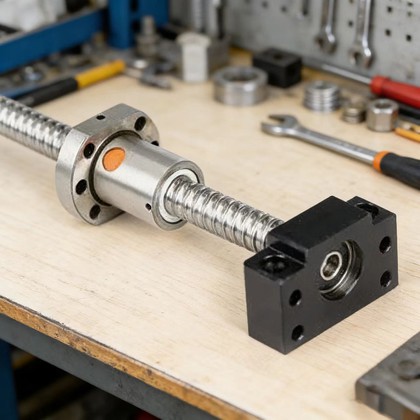
Product Application Scene
Frequently Asked Questions on Ball Screw Support Selection and Use(FAQ)
|
Q: What causes vibration during ball screw operation and positioning inaccuracies? A: This is typically caused by an incompatible mount model, poor coaxiality, incorrect installation of the fixed end and support end, or insufficient bearing precision. The issue can be resolved by recalibrating the installation accuracy and replacing the mount with the correct model.
Q: What should I do if there is abnormal noise or excessive heat during operation? A: Common causes include excessive preload, insufficient lubrication, or dust entering the bearings. Clean out debris, replenish grease, and slightly loosen the locking nut.
Q: Long-stroke lead screws tend to sag. How can this be resolved? A: Select high-rigidity, heavy-duty brackets or add intermediate support structures to prevent the lead screw from sagging due to its own weight, which affects accuracy.
Q: Can brackets from different brands be mixed and matched? A: Bearings of the same model and size are generally compatible, but it is recommended that the fixed end and support end use the same brand and series to ensure precision matching.
Q: Can the fixed end and support end be installed interchangeably? A: No, they cannot be interchanged. The fixed end is designed to withstand axial forces, while the support end provides only radial support. Interchanging them will prevent the release of thermal expansion in the lead screw, potentially causing jamming, abnormal noises, or even bending and breakage of the lead screw.
Q: How can I tell if the bearings in a ball screw support are damaged? A: If you experience noticeable stuttering, a dry or gritty sensation, or periodic abnormal noises when rotating the screw; if the temperature of the support area rises rapidly during operation; or if there is significant axial play or radial runout, replacement is required if any of these conditions are met.
Q: Which type of bracket should be selected in humid environments or where cutting fluid is present? A: Prioritize brackets with dual oil seals, metal dust covers, and housings treated for rust prevention (e.g., nickel-plated or blackened). These provide effective protection against water, cutting fluid, and rust.
Q: Can standard bearings be used for lead screws operating at very high speeds? A: No. In high-speed applications, specialized high-speed bearing housings must be used. Standard housings will overheat and burn out, and precision will drop sharply due to insufficient bearing speed limits.
Q: Why is there excessive axial play in the lead screw after installation? A: This is primarily caused by the locking nut not being tightened properly, insufficient bearing preload, or the bracket itself failing to meet precision standards. Retighten the locking nut and check the bearing preload configuration; replace the bracket if necessary.
Q: Standard brackets are prone to failure under heavy-load conditions. How should I select the appropriate model? A: For heavy-load applications, select high-rigidity, heavy-duty brackets. Prioritize configurations with matched angular contact bearings, and choose housings made of cast iron or alloy steel. Additionally, select larger-sized brackets to enhance load-bearing capacity and rigidity, thereby preventing deformation or damage caused by excessive stress.
Q: What should be done if the bracket becomes loose after some time in use? A: First, check whether the mounting bolts and lock nuts are loose and retighten them. If looseness persists, inspect the mounting surface for wear and the housing for deformation. If the mounting surface is worn, grind it flat; if the housing is deformed, replace the bearing housing. Additionally, install anti-loosening washers on the bolts to enhance anti-loosening performance and prevent future loosening. |
References
Specifications for Installation and Commissioning of Ball Screw Support Units. China Machinery Industry Standards Service Network
Precision Transmission Components Selection Manual. Chinese Society of Mechanical Engineers
Maintenance Guide for CNC Machine Tool Ball Screw Systems. CNC Technology Network
Key Design Considerations for Ball Screw Support Structures in Automation Equipment. Industrial Control Network
Technical Data on Selection and Application of Ball Screw Support Units. Misumi Official Technical Documentation
Contact Us
📧 Email: lsjiesheng@gmail.com
🌐 Official website: https://www.automation-js.com/


