

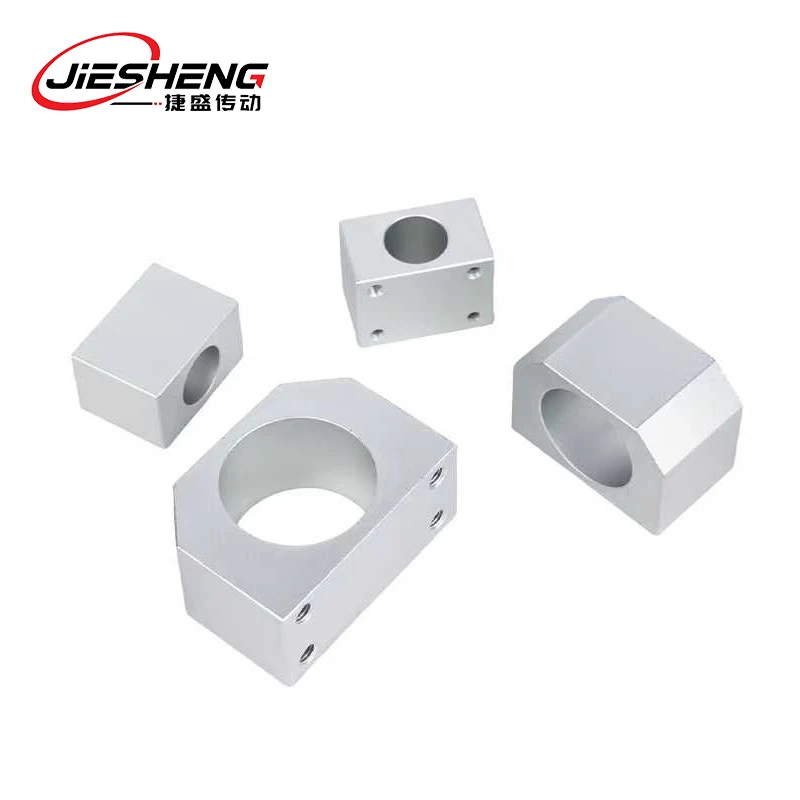
How to Improve the Motion Accuracy of Nut Housings?
In the fields of mechanical transmission and precision assembly, many hold misconceptions about "enhancing the motion accuracy of nut housings." Some believe that "as long as dimensional accuracy is ensured during machining, motion accuracy will naturally meet standards," overlooking the impact of assembly clearances and lubrication conditions on motion precision. Others excessively pursue machining precision (e.g., enforcing tolerances at IT5 or higher), driving up costs without significant performance gains. Still others neglect maintenance during operation, causing originally compliant motion precision to rapidly deteriorate due to wear and deformation. In reality, the motion precision of nut housings (such as radial runout, axial play, and fit clearance stability) is the combined result of the entire "machining - assembly - maintenance" process. It requires multi-dimensional optimization from material selection, machining processes, assembly control, and operational maintenance, tailored to the precision demands of specific application scenarios (e.g., precision machine tools, automated equipment). If any link in this chain is weak, even the highest machining precision will significantly compromise the final motion accuracy. Today, we'll start by examining the factors affecting precision, then break down the core methods for improving nut housing motion accuracy and the key points for full-process control, helping you systematically solve precision issues.

First, Clarify: Core Metrics and Influencing Factors for Nut Housing Motion Accuracy
To enhance nut housing motion precision, clearly define "what precision metrics are" and "which factors impact precision" to avoid blind optimization. The relationship between core metrics and influencing factors forms the foundation for developing optimization strategies.
1. Three Core Metrics for Nut Housing Motion Precision
The motion precision of nut housings primarily manifests in the stability of relative motion with shafts and mating components. Key metrics include:
Radial Runout: The radial deviation of the outer circumference or end face when the nut housing rotates around the shaft. Typically required to be ≤0.01-0.03mm (for precision applications). Exceeding this tolerance causes vibration and increased noise in mating components. For example, a machine tool nut housing with 0.05mm radial runout caused fluctuating gear meshing clearance, resulting in machining accuracy deviations.
Axial play: Reciprocating displacement deviation along the axial direction, typically required ≤0.005-0.01mm (high-precision transmission). Excessive play causes positioning errors. For example, axial play of 0.02mm in an automated manipulator nut housing reduces positioning accuracy from ±0.01mm to ±0.03mm.
Clearance Stability: Variation in clearance between the nut housing and components like shafts or spacers during motion.
Requirement: ≤0.003mm (long-term use). Unstable clearance causes fluctuating motion resistance.
2. Four Key Factors Affecting Nut Housing Motion Accuracy
From production to operation, multiple stages impact motion precision. Core factors can be categorized into four types:
Excessive bore roundness (e.g., 0.008mm) causes uneven fit clearance with the shaft, increasing radial runout during motion. Excessive end face-to-bore perpendicularity (e.g., 0.01mm/m) induces axial play. For instance, a nut housing with 0.015mm/m perpendicularity deviation exhibits 0.02mm axial play after assembly;
Assembly Process: Coaxiality calibration during assembly, bolt tightening torque, and shim selection directly impact motion accuracy.
Insufficient lubrication accelerates wear, increasing clearance. For instance, a nut housing not lubricated regularly saw its clearance increase from 0.005mm to 0.012mm after 6 months of use. Environmental dust ingress causes localized wear, triggering excessive radial runout.
Second, Assembly Phase: Precisely control fits and positioning to realize machining accuracy.
After achieving machining accuracy, assembly control directly determines the nut housing's final motion precision. This requires coaxiality calibration, tightening control, and shim adaptation to ensure stable fit between the housing, shaft, and equipment.
1. Coaxiality Calibration: Preventing precision loss from "eccentric assembly"
Coaxiality between the nut housing, shaft, and equipment base is critical for motion accuracy. Professional tools must calibrate this to ensure deviation ≤0.005-0.01mm/m:
Shaft-to-housing coaxiality calibration: Secure the shaft on a precision fixture. Mount a dial indicator on the shaft with its dial aligned to the nut housing's bore.Deviation must be ≤0.01mm/m. If out of tolerance, adjust housing position using precision shims (0.005mm thickness) beneath the base until compliance is achieved.
2. Torque Control for Bolting: Prevent housing deformation causing uneven clearance.
Tightening Sequence: Employ the "diagonal symmetrical" tightening method (e.g., for a four-bolt housing: top-left → bottom-right → top-right → bottom-left). Apply 50% of the rated torque per tightening cycle, repeating 2-3 times to progressively reach the rated torque. This prevents stress concentration from single-cycle tightening.
Torque verification: After tightening, randomly inspect bolt torques using a torque wrench (inspection rate ≥30%). Torque deviation must be ≤±5%. If a bolt's torque deviates by 10% (e.g., rated 20 N·m, measured 18 N·m), retighten it to the rated value.
Third, Usage and Maintenance: Mitigating Precision Degradation and Extending High-Precision Lifespan
Wear Monitoring and Repair: Prompt intervention to prevent precision degradation
Regularly inspect nut housing wear. Address excessive wear immediately to prevent further precision deterioration:
Regular Inspection: Monthly radial runout and axial play checks using a dial indicator.
Repair Methods: Minor wear (e.g., clearance increase ≤0.003mm) can be corrected by grinding the bore (using diamond grinding compound to restore IT6 precision). Severe wear (e.g., radial runout >0.03mm) requires housing replacement to prevent compromising overall equipment accuracy. A nut housing on an automated robotic arm was restored via grinding, reducing clearance from 0.01mm to 0.006mm and achieving motion accuracy standards.
Summary
Enhancing nut housing motion precision hinges on controlling key points throughout the entire "manufacturing - assembly - operation/maintenance" lifecycle:
- Manufacturing: Establish precision foundations through material selection and process optimization.
- Assembly: Unlock precision potential via concentricity calibration and torque control.
- Operation/Maintenance: Sustain precision stability through lubrication, monitoring, and environmental management. Avoid over-optimizing any single stage while neglecting others. Develop balanced, efficient optimization strategies tailored to actual application precision requirements and operating conditions. This ensures long-term high-quality motion precision for nut housings, providing reliable assurance for overall equipment performance.
Contact Us
📞 Phone: +86-8613116375959
📧 Email: 741097243@qq.com
🌐 Official website: https://www.automation-js.com/


