

The influence of Bearing washers on the performance of precision machinery
Bearing washers As a key part of precision machinery to fix the position of bearings and limit axial displacement, it seems to be a simple structure, but it plays an irreplaceable role in the maintenance of the precision of mechanical systems, operational stability, and life continuation. In the high-precision requirements of the equipment (such as aerospace test instruments, precision machining centers, biomedical testing equipment), the performance differences in the retaining ring may directly determine whether the equipment can achieve the design indicators, its specific impact is reflected in a number of dimensions.
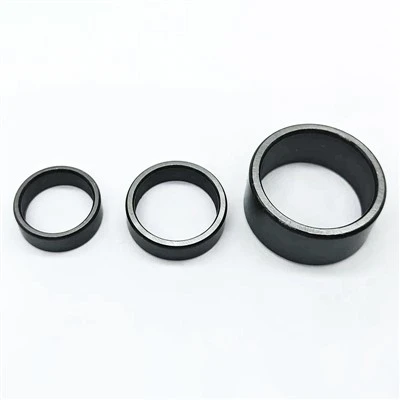
First, the basic impact on positioning accuracy
The positioning accuracy of precision machinery (such as coordinate measuring machine spatial positioning error needs to be controlled at the micron level) depends on the relative positional stability of the components, and bearing retaining ring through the constraints of the axial clearance of the bearing, become the positioning accuracy of the "first line of defense".
Bearing in the work will be due to temperature changes, load fluctuations produce small axial displacement, retaining ring needs to be through the bearing inner ring or outer ring of the close fit, this displacement is limited to the allowable range. If the flatness of the end face of the retaining ring is insufficient (such as the existence of localized bumps), it will lead to uneven stress on the inner ring of the bearing, and there is a small tilt. This tilt may appear to be subtle (perhaps only a few seconds of angular deviation), but amplified by the transmission of the mechanical structure, it may produce significant positional deviations in the end-effector (e.g., the tool in a machining center, the probe in a measuring instrument). For example, in a precision boring machine, if the spindle bearing retaining ring has a flatness error of 0.005mm, the coaxiality of the machined hole system may exceed the design requirements by a factor of 3-5, resulting in a scrap part.
In addition, the accuracy of the retaining ring and the shaft or hole will also affect the positioning stability. If the tolerance of the inner diameter of the shaft retaining ring is too large, and the shaft with the gap, in the equipment start and stop or change direction, the retaining ring may produce a small fluctuation, this fluctuation will be transmitted to the entire shaft system through the bearing, so that the precision worktable repeat positioning accuracy decreased. For the need for continuous operation of automation equipment (such as chip packaging machine), the accumulation of this positioning deviation may lead to a significant reduction in product yield.
Second, the decisive role of the shaft bearing force state
The service life of the bearing is closely related to the force uniformity, and the design and installation quality of the retaining ring directly affects the load distribution of the bearing.
Bearing in bearing axial load, the force will be transmitted to the retaining ring through the inner or outer ring, and then dispersed by the retaining ring to the shaft or seat. If the thickness of the retaining ring is not uniform, or the contact area with the bearing is insufficient, it will lead to the force transmission path is concentrated in the local area, so that the bearing raceway and roller contact stress rises sharply. In this state for a long time, the bearing raceway is prone to early fatigue spalling, and the roller surface will also produce wear marks, which in turn affects the rotational accuracy of the bearing. For example, in high-speed motors, the localized force concentration of the bearing retaining ring may cause the bearing temperature to rise abnormally, which not only shortens the life of the bearing, but also may further aggravate the precision deviation of the shaft system due to thermal deformation.
For precision machinery subjected to alternating loads (such as robot joints), the elastic deformation characteristics of the retaining ring is also critical. The elastic retaining ring needs to absorb the impact through its own micro-deformation when the load changes. If the retaining ring's elasticity is insufficient or there are cracks, it may fracture under the impact load, resulting in an instantaneous loss of bearing constraints and triggering serious equipment failures. Even if it is not fractured, the rigidity of the retaining ring will be too large impact will be directly transmitted to the bearing, accelerating its aging.
Third, on the stability of operation and vibration noise impact
precision machinery on the operation of vibration and noise have strict requirements (such as laboratory equipment need to maintain extremely low vibration levels), and bearing retaining ring is one of the key factors affecting the vibration characteristics of the system.
When there are deviations in the fit of the retaining ring with the bearing and shaft system, periodic mechanical impacts will be generated during the rotation process. For example, if there is a burr at the opening of the elastic retaining ring, intermittent friction will occur with the inner ring of the bearing when rotating, generating high-frequency vibration. This vibration, although the amplitude is small, but may form a resonance with the intrinsic frequency of the equipment, amplifying the vibration effect. In optical precision instruments, this resonance can interfere with the stability of the optical path, resulting in blurred imaging or fluctuations in measurement data.
Noise generation is also closely related to the accuracy of the retaining ring. The roughness of the surface of the retaining ring exceeds the standard, and the fit gap with the bearing is unreasonable, will produce friction noise or impact noise during the relative motion. For medical equipment (such as nuclear magnetic resonance machine), this additional noise not only affects the experience of using the equipment, but also may interfere with the signal acquisition of precision sensors, affecting the accuracy of the test results.
Fourth.Long-term Impact on Equipment Life and Maintenance Costs
Bearing washers quality problems are often not immediately apparent, but rather affect the life of the equipment through "chronic damage" while increasing maintenance costs.
If the retaining ring material strength is insufficient or poor heat treatment process, in the long-term bearing axial load will gradually produce plastic deformation. After the deformation of the retaining ring can not effectively limit the displacement of the bearing, resulting in increased bearing clearance, vibration and noise during operation, forming a vicious circle. For example, in the main shaft system of a wind turbine, the deformation of the retaining ring can lead to premature bearing failure, which not only requires high costs for a bearing replacement, but also results in days of downtime.
In addition, the quality of the retaining ring installation can also affect the frequency of maintenance. If the retaining ring is not fully embedded in the groove or is skewed, it can accelerate the wear of the ring and the bearing, resulting in more frequent downtime for maintenance. For the key equipment in the production line (such as automotive welding robots), frequent maintenance will disrupt the production rhythm and reduce production efficiency.
Fifth, the impact of the adaptability of special working conditions
In some extreme working conditions (such as high temperature, low temperature, corrosive environment), the performance of the bearing retaining ring on the adaptability of precision machinery is critical.
In a high-temperature environment (such as aircraft engine test equipment), the retaining ring needs to withstand temperature changes brought about by thermal expansion and contraction. If the retaining ring is not thermally stable enough, the uneven expansion may lead to too large or too small a clearance with the bearing: too large a clearance loses its positioning effect, while too small a clearance may jam the bearing and cause serious failures. In low-temperature environments (such as low-temperature physics laboratory equipment), the brittleness of the retaining ring material increases, if the design does not take into account the low-temperature toughness, may be fractured under the vibration load.
In corrosive environments (such as marine monitoring equipment), the corrosion resistance of the retaining ring directly determines the reliability of the equipment. If the retaining ring is made of ordinary steel and no anti-corrosion treatment, it will produce volume expansion due to corrosion, and this expansion may squeeze the bearing, resulting in increased rotational resistance; at the same time, the debris produced by corrosion may also enter the bearing, exacerbating wear.

In summary, the impact of Bearing washers on the performance of precision machinery is all-round and deep. It is not only a simple positioning parts, but also to ensure the accuracy of the mechanical system, stability and life of the core elements. In the design, manufacture and maintenance of precision machinery, need to pay full attention to the selection of retaining ring, machining accuracy and installation process, in order to ensure that the equipment to maintain the best long-term performance.
Contact Us
📞 Phone: +86-8613116375959
📧 Email: 741097243@qq.com
🌐 Official website: https://www.automation-js.com/


