

What factors affect the load capacity of linear guides?
Hey! As a supplier specializing in linear guide rail sales and technical support, I get asked daily: "Why does my selected linear guide rail, clearly rated for 500kg, deform under just 300kg?" "Why do other suppliers claim 400kN load capacity for the same specs, while yours only rates 350kN-is it lower quality?" The load capacity of linear guides isn't a "fixed number." It's like how much water a cup can hold-it depends not only on the cup's size but also on its material, placement angle, and filling speed. Often, it's not poor guide quality but misunderstanding the key factors affecting load capacity. Today, following the actual process we use to solve load capacity issues for clients, I'll guide you step by step through the factors affecting linear guide load capacity using the "Article Structure 1" framework. This will help you select guides that can truly handle the load.

Step 1: An 8-Step Practical Guide to Deconstructing Linear Guide Load Capacity Factors
First, clarify your "project load requirements" - knowing the load capacity needed reveals the critical influencing points.
To understand the factors, you must first be clear about your project's "actual load capacity requirements" and "how the load is applied," avoiding distraction by irrelevant factors:
What "type" of load are you handling?
Linear guide load capacity is categorized into "radial load," "axial load," and "combined load" (simultaneous radial + axial forces).
For laser cutting machine guides, cutting reaction forces impose combined loads (e.g., radial 150kg + axial 50kg).
Different load types impose distinct requirements: Radial load primarily depends on the guide's "cross-sectional rigidity," axial load on the "meshing strength between the slider and guide," while composite load demands consideration of both.
Do you require "long-term load capacity" or "short-term impact load capacity"?
Long-term load capacity is determined by the guide rail's "rated dynamic load" (C), representing the sustained dynamic load it can handle. Short-term impact load capacity is determined by the "rated static load" (C0), indicating the maximum instantaneous load, typically 2-3 times C. For example, if a guide rail has a rated dynamic load C=15kN (can sustain 1500kg continuously) and a rated static load C0=30kN (can withstand 3000kg momentarily), subjecting it to 2000kg continuously will cause fatigue failure within a year.
Do your "operating speed" and "frequency" affect load capacity?
At low speeds (≤1m/s), the primary load impact on the guide is static pressure. At high speeds (>1m/s), "inertial forces" are generated, effectively adding extra load.
Step 2: Examine the "Linear Guide Material" - Material is the foundation for load-bearing capacity; inferior material is useless regardless of thickness.
The material of a linear guide directly determines its "strength" and "fatigue resistance," forming the core foundation of its load capacity. Focus on the materials of two key components:
The base material of the guide rail and slider
Mainstream materials include "high-carbon chromium bearing steel" or "alloy structural steel.".
Avoid using ordinary carbon steel for guide rails. Q235 steel has a hardness of only HRC20-25 and a tensile strength ≤500MPa, easily deforming under 100kg loads. A previous customer opted for Q235 guide rails to save costs, but they bent within three months. After switching to SUJ2 steel, the guide rails handled 300kg loads without issue.
Ball/Roller Material
Balls (or rollers) act as the force transmitters for the guide rail and must be made of high-strength material. Typically, "GCr15 bearing steel" is selected. After precision grinding and heat treatment, it achieves a hardness of HRC60-64 and a compressive strength ≥3200MPa, enabling uniform load distribution. Substandard balls made from ordinary steel lack sufficient hardness. Under load, they deform under pressure, causing guide stuttering or even damage.
High-end guide balls also undergo "surface hardening treatment," increasing surface hardness by 5%-10% and extending fatigue life by 20%-30%, making them suitable for long-term high-load operation.
Step 3: Match the "Linear Guide Dimensions" - Incorrect sizing renders even premium materials useless.
Linear guide dimensions directly impact load capacity. It's not about "bigger is better," but about "precise matching." Focus on three critical dimensions:
When selecting, refer to the manufacturer's "Dimension-Load Capacity Chart" to choose the smallest suitable cross-section based on actual load requirements. For a 10kN load, a 30mm-wide rail suffices-there's no need to select a 40mm one.
Slider Dimensions and Quantity
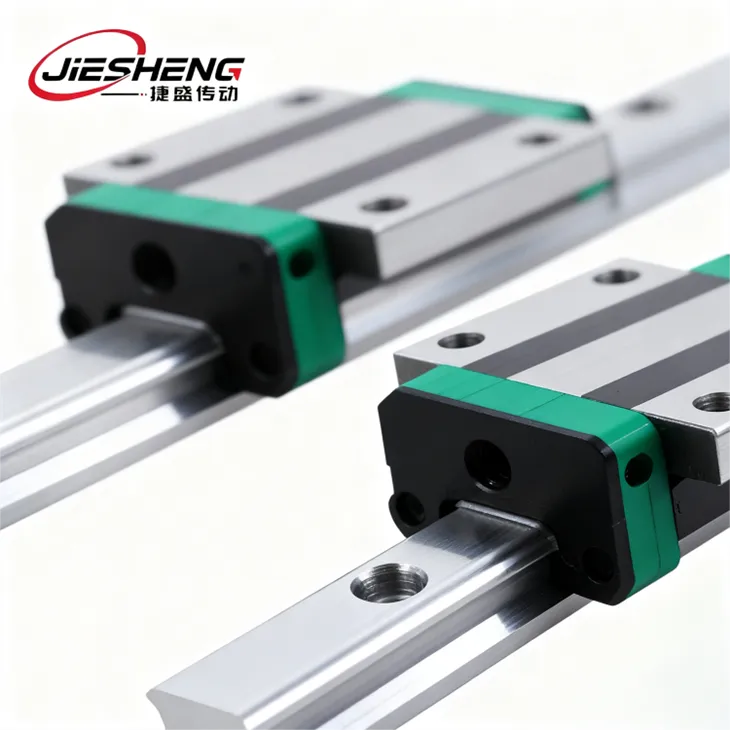
Longer sliders increase contact area with the rail, enhancing load capacity. For example, with the same rail specification, using short sliders (30mm length) yields a rated dynamic load C=10kN, while long sliders (50mm length) achieve C=15kN-a 50% load increase. Additionally, more sliders further boost load capacity.
A previous customer's workbench weighed 20kN but only had two short sliders installed, causing deformation. After switching to three long sliders, the load distribution became even, resolving the issue.
Ball/Roller Diameter and Quantity
Larger ball diameters withstand greater pressure: a single 5mm ball supports 1kN, while an 8mm ball supports 2.5kN. Simultaneously, increasing the number of balls within a slider enhances its total load capacity. For instance, a slider with 10 x 5mm balls has a total load capacity of approximately 8kN (accounting for uneven force distribution, not 10×1kN); a slider with 15 x 5mm balls has a total load capacity of approximately 12kN.
Step 4: Evaluate "Linear Guide Precision and Surface Quality" - Precision and surface quality conceal "hidden load capacity"
Many assume "precision and surface quality don't affect load capacity," but this is incorrect. Guides with poor precision or rough surfaces experience significantly reduced actual load capacity:
Guide Parallelism and Straightness
Significant parallelism error causes the slider to "jerk" during operation, leading to localized stress concentration. For example, a guide originally rated for 10kN may only handle 7kN due to poor parallelism. When localized pressure exceeds material limits, deformation or wear occurs. Similarly, high straightness error causes uneven load distribution, reducing actual load capacity.
A previous customer's guide rail with a straightness error of 0.02mm/m exhibited abnormal noise under an 8kN load. After calibration to 0.005mm/m, it operated smoothly even under a 10kN load.
Surface Finish and Hardness Uniformity
The surface finish of guide rails and slides must exceed Ra 0.4μm. Poor finish increases friction resistance and causes uneven load transfer, reducing actual load capacity by 15%-20%. Additionally, material hardness must be uniform. Localized low hardness causes deformation at softer points during loading, diminishing overall load capacity.
Verify compliance through "hardness tester inspections" and "surface roughness gauge tests" to ensure surface quality meets standards and prevent "hidden load reduction."
Step 5: Consider "Mounting Methods and Compatibility" - Improper Installation Equals "Underutilized" Guide Rails
The mounting method directly impacts the guide rail's load-bearing capability. Even high-capacity rails become ineffective if installed incorrectly:
Mounting Fixation Method
Rails must be secured with sufficient screws.
Slider-to-Workbench Connection Method
The slider and workbench must be "rigidly connected," not "flexibly connected." Otherwise, the workbench will vibrate under load, effectively adding extra load and reducing the guide rail's actual load capacity.
Compatibility with Other Components
The guide rail must be compatible with the equipment's "drive system." The drive system's output force must not exceed the guide rail's load capacity. If the motor output thrust is 5kN, the guide rail's axial load capacity must be at least 6kN (with a 20% margin), otherwise the guide rail will operate under prolonged overload conditions.
Step 6: Adapt to "Operating Environment Conditions" - Harsh Environments Reduce Load Capacity
Harsh environments accelerate rail wear and corrosion, diminishing load capacity. Three common impactful environments include:
Humid / Corrosive Environments
Moisture causes rail rusting, while corrosion degrades material structure. SUJ2 steel rails rust within one year in humid conditions, reducing load capacity by 30%. Exposure to acidic or alkaline solutions accelerates corrosion, halving load capacity within six months. In such cases, select stainless steel rails or apply anti-corrosion treatment to standard rails to mitigate environmental impact on load capacity.
Dusty / Contaminated Environments
Contaminants like dust and iron filings entering between the guide rail and slider act like "sand in a bearing," accelerating wear. This increases guide rail clearance, causes uneven force distribution during loading, and reduces actual load capacity by 20%-25%.
High-Temperature Environments (>60°C)
High temperatures reduce the hardness of guide rail materials. For example, SUJ2 steel's hardness drops from HRC60 to HRC50 at 150°C, decreasing load capacity by 15%. At 200°C, hardness falls to HRC40, reducing load capacity by 30%. In such cases, select guide rails made of high-temperature-resistant materials or install cooling devices to prevent high temperatures from affecting load capacity.
Step 7: Verify "Linear Guide Quality and Certification" - Substandard Guides Often Feature "Inflated" Load Ratings
Some guides on the market claim high load capacities that cannot be achieved in practice, indicating quality issues. When selecting guides, pay attention to:
Review the manufacturer's load testing reports.
Reputable manufacturers conduct "rated dynamic load tests" (operating under rated load for 1 million cycles to observe wear and deformation) and "rated static load tests," providing detailed test reports. Substandard rails undergo no testing; their rated load capacity is merely a "theoretical value," often only 60%-70% of the stated capacity in practice.
Check industry standards and certifications
Linear guides must comply with "ISO standards" or "national standards." Export products also require certifications like CE or FDA. These standards specify testing methods and labeling requirements for load capacity, preventing false claims. Uncertified guides offer no quality assurance, and their load capacity claims are unreliable.
Conduct actual sample testing
For bulk purchases, perform "small load tests" on samples (applying 80% of rated load for 100,000 cycles to observe performance). This verifies actual load capacity and prevents batch failures.
Step 8: Balance Cost and Load Capacity-Higher Isn't Always Better, Sufficient Is Sufficient
Finally, consider cost. Higher load capacity rails command higher prices. Balance "meeting requirements" with "controlling costs":
Short-Term Light Load (Within 1 year, load ≤5kN)
Choose economical rails priced at several hundred yuan each. They meet requirements without needing premium models.
| Influencing Factor | Specific Parameter/Condition | Load Capacity Performance | Typical Application Scene |
| Material Property | SUJ2 Steel (Hardness HRC58-62) | Rated Dynamic Load 15kN (1500kg Long-Term) | Medium-Heavy Machine Tool Guides |
| Dimensional Parameter | Guide Rail Section 30mm×22mm + Long Slider 50mm | Rated Dynamic Load 18kN (Double vs 20mm Section) | Automated Assembly Line Workbenches |
| Environmental Condition | Humid Environment (SUJ2 Steel Without Anti-Corrosion) | Load Capacity Drops 30% After 1 Year (15kN→10.5kN) | Unprotected Workshop Assembly Lines |
| Installation Method | 1m Guide Rail with 4 M6 Screws (Torque 8-10N·m) | Stable Load 8kN (Only 5kN Before Supplementary Installation) | Light Laser Cutting Machine Guides |
Conclusion: The core factors influencing linear guide load capacity are: "Material forms the foundation, dimensions determine critical performance, installation ensures reliability, and environmental conditions provide supplementary support."
In summary, linear guide load capacity is influenced by multiple factors including material, dimensions, precision, installation, environment, and quality. It cannot be determined by a single metric but requires comprehensive evaluation. When selecting guides, don't just focus on the rated load value. Consider your specific load type, operating conditions, and installation method. Choose products with test reports that meet standards to ensure you select guides that "truly deliver.".
Contact Us
📞 Phone: +86-8613116375959
📧 Email: 741097243@qq.com
🌐 Official website: https://www.automation-js.com/


