

"Does non-compliant surface roughness of the spindle locking nut cause excessive spindle runout accuracy?" "Does selecting incorrect roughness parameters lead to accelerated locking nut wear and frequent replacements resulting in significant losses?" " Unclear standards for different operating conditions lead to blind machining and product scrap?" As an engineer specializing in precision mechanical transmission for 12 years, such questions about spindle lock nut surface roughness are extremely common. The core issues often stem from insufficient understanding of the critical impact of surface roughness, unclear standards for different operating conditions, non-standardized testing methods, or neglecting the synergistic matching of roughness with other parameters. As a core fastening component in precision machine tools and machining centers, the spindle locking nut plays a critical role in securing the spindle bearing and ensuring positioning accuracy of the shaft system. Its surface roughness directly determines locking reliability, fit precision, and service life. In practice, determining the surface roughness of a spindle locking nut isn't simply a matter of "the more precise, the better." It requires a systematic approach of "precise matching + scientific control" tailored to operational demands and mating methods. Today, we'll guide you through an eight-step framework to comprehensively analyze spindle locking nut surface roughness-from core definitions to practical implementation-so you can understand "what to choose, why to choose it, and how to ensure it."
Step 1: 8-Step Practical Analysis of Spindle Locking Nut Surface Roughness
Define Core Concepts-First Grasp the Key Meaning of "Surface Roughness"
To accurately determine the surface roughness of a spindle locking nut, one must first clarify core concepts, characteristic parameters, and key influencing factors to avoid selection errors caused by misconceptions:
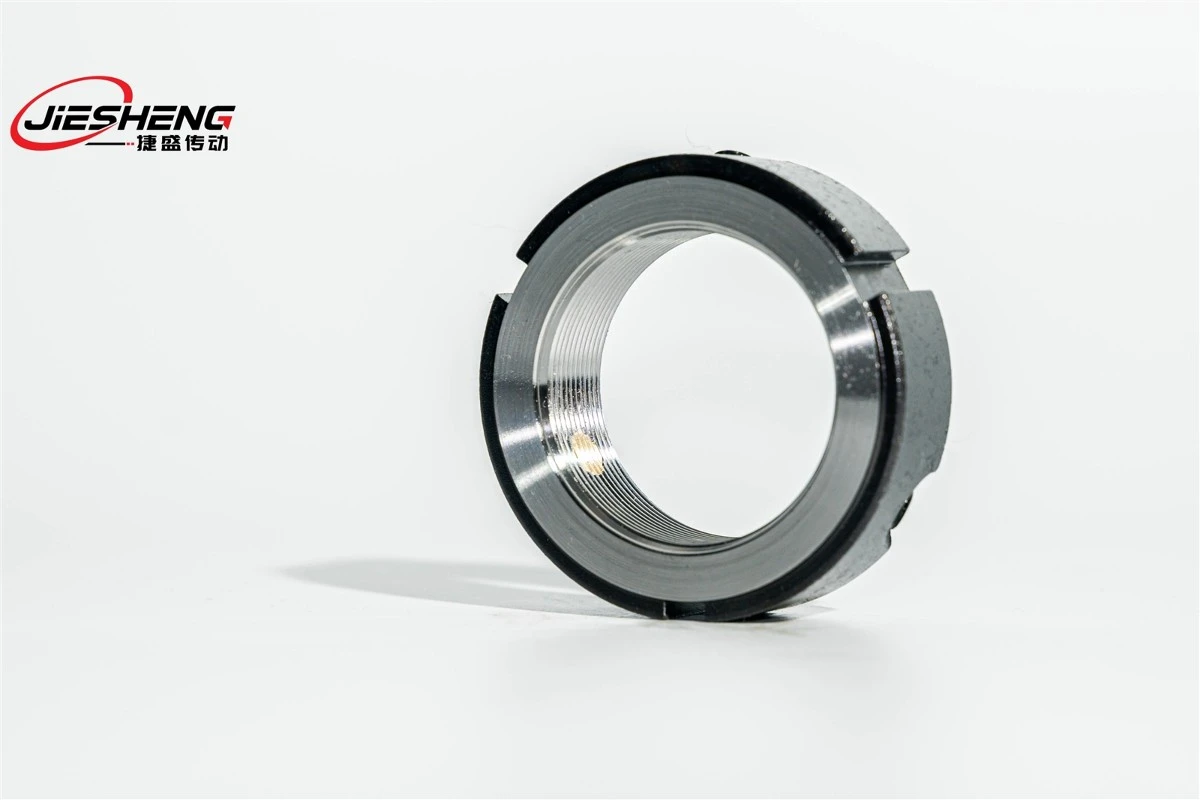
Surface roughness of spindle locking nuts refers to the irregularity of their working surface micro-profile, serving as a core metric for evaluating surface machining quality. Its primary characteristic parameter is Ra-the arithmetic mean of absolute profile deviation values within a sampling length, measured in μm. A lower Ra value indicates a smoother surface, while a higher Ra value signifies a rougher surface.
Industry Core Characteristic Parameters:
- Ra (Arithmetic Mean Roughness): The most commonly used parameter, applicable for inspecting mating surfaces and threaded surfaces of spindle locking nuts. It directly reflects surface flatness.
- Rz (Maximum Height Roughness): A supplementary parameter indicating the maximum difference between surface peaks and valleys. Used for additional inspection in heavy-load or impact conditions to ensure no sharp protrusions exist.
- Core Correlation Requirements: Surface roughness of spindle locking nuts must coordinate with dimensional accuracy and geometric tolerances. For example, the Ra value of mating surfaces for H6-grade precision nuts must ≤0.8μm to guarantee fit accuracy.
Step 2: Surface Roughness Adaptation Standards for Different Operating Conditions-Precise Matching is Key
There is no universal standard for spindle locking nut surface roughness. It must be precisely matched based on equipment type, operating load, and accuracy requirements. Blind pursuit of high precision increases processing costs, while insufficient precision leads to performance failure. Below are the matching standards and rationale for four typical operating conditions:
- Corrosive/Humid Environment Conditions:
- Core Requirements: Corrosion resistance, anti-loosening properties, suitability for humid/corrosive media environments;
- Compatibility Standards: Contact surface Ra ≤ 0.8μm, thread engagement surface Ra ≤ 0.8μm, paired with anti-corrosion coating;
- Selection Basis: Smooth surfaces reduce adhesion of corrosive media, lowering rust risk; Combined with anti-corrosion coatings further enhances corrosion resistance.

Step 3: Coordinated Matching of Surface Roughness with Other Parameters-Avoiding Single-Parameter Optimization Pitfalls
The performance of spindle lock nuts relies on multi-parameter coordination. Surface roughness must precisely match dimensional accuracy, geometric tolerances, and material properties. Otherwise, "single-parameter compliance may lead to overall performance failure":
- Matching with dimensional accuracy:
- High-precision dimensions: Requires low roughness to ensure stable clearance stability;
- Standard-precision dimensions: Medium roughness (Ra=1.6μm) suffices. Excessive pursuit of low roughness increases machining costs without performance gains.
- Matching with geometric tolerances:
- High flatness requirements for mating surfaces: Requires Ra ≤ 0.8 μm roughness; otherwise, flatness accuracy is compromised by surface micro-peaks and valleys.
- High coaxiality requirements for threads: Requires Ra ≤ 0.8 μm thread roughness to prevent increased coaxiality deviation due to thread wear.
Step 4: Surface Roughness Inspection Methods and Tool Selection-Ensuring Accurate and Reliable Results
Precise inspection is critical for ensuring surface roughness compliance. Select appropriate methods and tools based on inspection scenarios and accuracy requirements to prevent misjudgments due to measurement errors:
- Core Inspection Methods:
- Contact-based Inspection:
- Tools: Roughness tester (accuracy ≥0.001μm);
- Procedure: Select 3 uniformly distributed measurement points. Sample length follows standards.
- Tool Selection Principles:
- Precision inspection: Use contact roughness meters to ensure accuracy;
- Mass production inspection: Use laser roughness meters to balance efficiency and precision;
- On-site maintenance screening: Use reference blocks for rapid identification of significant deviations.
Step 5: Core Machining Factors Affecting Surface Roughness-Ensuring Quality at the Source
The surface roughness of spindle locking nuts is determined by machining processes. Core factors in the machining stages must be precisely controlled to prevent roughness exceeding tolerances due to machining defects:
- Grinding processing factors:
- Grinding wheel selection: Fine-grain wheels achieve low roughness, while coarse-grain wheels suit processing with Ra ≥ 1.6 μm. Wheels require regular dressing to prevent surface roughness caused by wheel dulling.
- Grinding parameters: Low grinding speeds and minimal stock removal (0.01–0.02 mm) reduce roughness. Simultaneously, control grinding temperature (≤150°C) to prevent thermal deformation causing surface micro-defects.
Step 6: Hazards and Troubleshooting Methods for Excessive Surface Roughness-Timely Mitigation of Performance Failure Risks
Excessive surface roughness directly causes spindle locking nut performance failure, triggering cascading malfunctions. Precise hazard identification and root cause analysis are essential:
- Core Hazards:
- Locking Loosening: Excessive Ra values on mating surfaces reduce contact area, causing stress concentration that accelerates torque decay and spindle play.
- Excessive Wear: High roughness accelerates wear on microscopic peaks and valleys, increasing clearance and shortening service life. Nuts with Ra=1.6μm last twice as long as those with Ra=3.2μm.
- Assembly Difficulty: Excessively low roughness creates strong adhesion between mating surfaces, causing "seizing" during assembly and increasing machining costs by over 30%.
- Non-Compliance Investigation Methods:
Re-test for Confirmation: Re-measure using a calibrated roughness tester to eliminate tooling errors; concurrently inspect testing conditions to prevent environmental interference with results.
Trace back to manufacturing: If testing confirms non-compliance, review machining processes-check tool wear, verify cutting/grinding parameters, and ensure grinding wheel dressing;
Assess usage impact: Minor deviations in non-critical applications may allow downgraded use; severe deviations require scrapping to prevent post-installation failures.
Step 7: Surface Roughness Quality Control and Certification-Ensuring Consistency in Mass Production
During mass production, establish a robust quality control mechanism to guarantee consistent surface roughness of spindle locking nuts and prevent batch nonconformities:
- Process Control:
- First-piece Inspection: Before each batch, machine 3 first-piece samples and conduct comprehensive surface roughness testing. Proceed with mass production only after passing inspection.
- Standard Certification and Inspection Reports:
- Compliance Standards: Domestic production must meet GB/T 1031-2009 "Surface Structure - Profile Parameters - Part 1: Terminology, Definitions and Parameters"; export products must comply with ISO 4287:1997 international standards.
- Inspection Reports: For batch deliveries, provide inspection reports from third-party authoritative institutions or internal corporate laboratories specifying Ra, Rz values, and testing methods to ensure product traceability.
Step 8: Cost Optimization Strategy for Surface Roughness-Balancing Performance and Cost
Higher surface roughness machining precision for spindle locking nuts increases costs. Optimize expenses while ensuring performance to avoid excessive investment:
- Select specifications based on requirements, rejecting "redundant precision":
- Standard conditions: Choose Ra=1.6μm, reducing machining costs by 20%-30% compared to Ra=0.8μm while fully meeting usage demands;
- Precision conditions: Precisely select Ra=0.4-0.8μm; avoid pursuing Ra=0.2μm (50% cost increase with negligible performance improvement).
- Optimize machining processes to reduce costs:
- For mass production, employ a "grinding + polishing" combined process (instead of pure polishing) to achieve Ra=0.4μm while reducing machining time by 30%;
- Select high-efficiency machining equipment to enhance processing efficiency and lower unit production costs.
Conclusion: Precision Matching + Collaborative Control Fortify Spindle Locking Nut Performance
In summary, there is no universal standard for spindle locking nut surface roughness. The core logic is: "Operating conditions → Precisely matched parameters → Collaborative multi-parameter alignment → Scientific inspection control → Balancing performance and cost." Essentially, it involves ensuring locking reliability, fit accuracy, and service life through rational surface roughness design. Common pitfalls in most enterprises include: "blind pursuit of high precision leading to cost wastage," "neglecting multi-parameter coordination causing performance failure," and "non-standard inspection resulting in non-conforming parts being installed," ultimately compromising equipment operational stability.
If you encounter issues during spindle locking nut surface roughness selection or inspection, follow this sequence: "First clarify operating conditions → Determine suitable roughness range → Verify multi-parameter coordination → Confirm via standardized inspection": For loosening, first check if the Ra value of the mating surface is too high. For assembly difficulties, first check if the roughness is too low. For precision drift, first check the compatibility between roughness and dimensional accuracy. Remember: Surface roughness of the spindle locking nut is a critical detail ensuring stable spindle system operation. Only through precise matching and scientific management can its fastening function be fully realized, laying a solid foundation for efficient equipment operation.
Contact Us
📧 Email: lsjiesheng@gmail.com
🌐 Official website: https://www.automation-js.com/


