

Hey! Many mechanical assembly and equipment maintenance technicians have a common misconception: whether Cylinder Linear Shafts can be used in marine environments depends solely on whether they're made of stainless steel. The consequences of this one-sided judgment are obvious-ordinary shafts used in marine environments will quickly rust and seize up, causing the cylinder's motion accuracy to decline. This not only leads to repeated replacement of parts and increased costs but can also result in equipment downtime and halted marine operations. In reality, linear shafts are perfectly suitable for marine environments. The key lies not in "whether it's stainless steel," but in whether it meets the specific demands of marine conditions. Today, we'll explain in plain terms the requirements for marine-grade linear shafts, guiding you to select the right solution for your specific application to avoid pitfalls and save time.
Core Insight: Avoid Adaptation Pitfalls and Identify Key Marine Environment Requirements
Many technicians selecting linear shafts for marine applications fall into a common trap: assuming any stainless steel material will suffice. In reality, stainless steel is merely a baseline. Whether a shaft can withstand the marine environment's "challenges" and perform reliably over time is the true test.
Salt spray and high humidity in marine environments act like "invisible corrosive agents," and relying on a single material is insufficient. Simply put, adapting for marine environments doesn't require complex theories-just focus on these key points: corrosion-resistant materials, surface protection, sealing of mating surfaces, and specialized lubrication. Achieving all these ensures stable operation of the linear axis cylinder, naturally avoiding rust and jamming issues, laying the groundwork for the specific adaptation points discussed below.
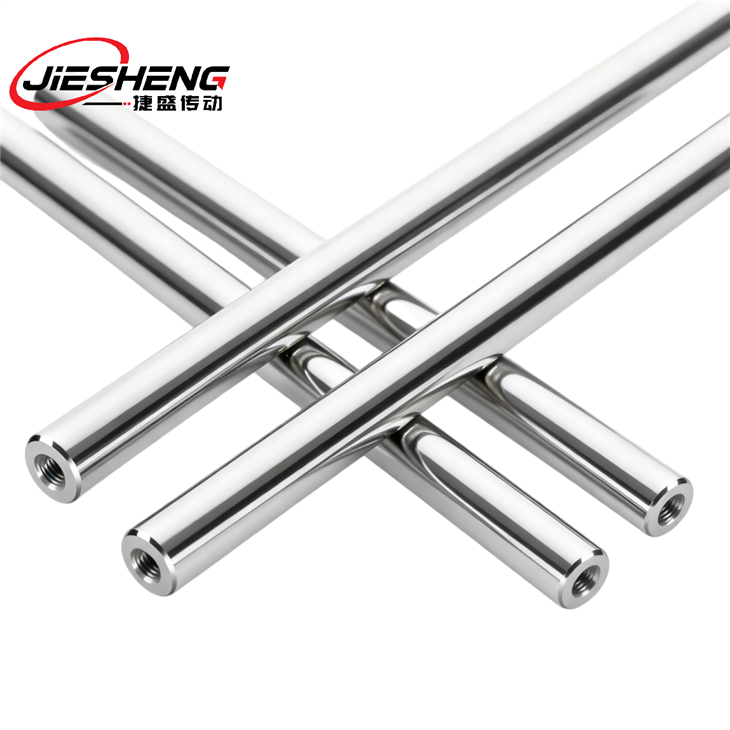
Practical Selection: No Need to Overthink-Match the Axis to the Application
For frontline technicians selecting linear axes for marine cylinders, there's no need to memorize complex theories or pore over technical specifications. Keep it simple-the core principle is "matching the application."
Forget agonizing over materials or protection details. First, clarify your equipment's operating environment: coastal with mild salt spray? Nearshore with frequent moisture splashes? Or offshore with occasional seawater immersion? Once you know this, simply cross-reference the selection table below to find the right linear cylinder. This avoids wasted costs and prevents future failures.
Forget obsessing over technical specs or chasing high-end configurations. Below, we've compiled selection tables for different marine environments. Simply match your scenario to instantly identify the right linear cylinder-ensuring compatibility while controlling costs.
The core impact of marine environments on linear cylinder shafts stems from corrosion caused by salt spray, high humidity, and similar media. This corrosion triggers a chain reaction of issues including jamming, wear, and precision degradation. To ensure a linear cylinder shaft's suitability for marine environments, four critical factors must be controlled. These are the key determinants of its performance in such conditions.
Adaptation Selection Comparison: A Single Table Reveals Core Differences
To visually compare cylinder linear axis adaptation solutions across different marine environments, we have compiled core selection parameters. Combined with operational scenarios, this enables rapid matching that balances adaptability and cost, avoiding blind choices:
|
Marine Environment Grade |
Recommended Material |
Surface Protection Coating |
Sealing Structure |
Applicable Operating Scenarios |
|
Mild Salt Spray (Coastal Nearshore, No Immersion) |
304 Stainless Steel |
Hard Anodizing |
Single-layer Dust Seal + Lip Seal |
Marine supporting equipment in coastal factories, offshore light operation equipment without seawater contact |
|
Moderate Salt Spray (Offshore, Short-term Water Vapor Splashing) |
316L Stainless Steel |
Hard Anodizing/ Teflon Coating |
Double-layer Dust Seal + Fluororubber Lip Seal |
Small offshore operation equipment, dock loading and unloading cylinder equipment |
|
Heavy Salt Spray / Short-term Immersion (Open Sea, Occasional Seawater Contact) |
316L Stainless Steel |
Teflon Coating |
Double-layer Dust Seal + Fluororubber Oil Seal + Waterproof Ring |
Open sea operation equipment, offshore platform auxiliary cylinder equipment |
|
Long-term Immersion (Direct Seawater Contact) |
Hastelloy / Titanium Alloy |
Teflon Coating |
Fully Sealed Waterproof Structure + Fluororubber Seals |
Underwater operation cylinder equipment, marine detection equipment |
Application Validation: 3 Steps to Mitigate Marine Environment Risks
After selecting a marine-grade linear shaft, pre-installation and trial operation validation are essential to prevent material, protection, or sealing failures. Follow these three simple steps to effectively mitigate risks:
Corrosion Resistance Inspection
After selecting a marine-grade linear shaft, conduct a corrosion resistance inspection as the foundation for preventing rust-related failures. Before installation, carefully examine the shaft surface, focusing on confirming no peeling coatings, scratches, or pitting. If feasible, perform a 24-hour simplified salt spray test. If the shaft shows no rust or blistering after testing, corrosion resistance is confirmed. After confirming corrosion resistance, proceed with subsequent seal performance testing to further mitigate operational risks.
Sealing Performance Testing
Simulate marine-level humidity and salt spray conditions by conducting no-load reciprocating motion tests on the Cylinder Linear Shaft. After continuous operation for 30 minutes, open the cylinder end cap to inspect the mating surface interior. Ensure no traces of salt spray or moisture ingress, with no leakage or deformation in the sealing structure, guaranteeing satisfactory sealing performance.
Operating Condition Adaptation Testing
Conduct loaded trial runs under actual equipment operating loads and speeds. Observe for stalling, abnormal noises, or precision deviation during linear shaft movement. Post-operation inspection confirms no surface wear or corrosion on the shaft body, verifying full adaptation to marine operating conditions.

Summary
Whether a Cylinder Linear Shaft can be used in marine environments fundamentally depends on its multi-dimensional adaptation to core marine characteristics like salt spray and high humidity-specifically in material selection, protection, sealing, and lubrication. These adaptation points directly determine the linear shaft's corrosion resistance, smooth motion, and structural stability, which in turn impact the cylinder equipment's operational precision, service life, and maintenance costs in marine environments.
Avoid the misconception that "stainless steel is sufficient" and refrain from blindly pursuing high-end corrosion-resistant materials that inflate costs. Prioritize identifying core marine environmental factors: salt fog concentration, seawater exposure, and immersion duration. Then, based on equipment load, rotational speed, and precision requirements, select corresponding solutions from these four key adaptation points to ensure stable operation of linear shafts in marine environments. Selecting the right adaptation solution not only guarantees the linear motion precision and operational stability of cylinder equipment but also reduces costs associated with component replacement and equipment downtime. This approach is far more efficient and better suited to the realities of marine operations than blind selection.
Contact Us
📧 Email: lsjiesheng@gmail.com
🌐 Official website: https://www.automation-js.com/


