

In the fields of linear motion, precision equipment, hydraulic and pneumatic systems, and heavy-duty machinery, bushings made of standard materials (such as plastic or cast iron) lack sufficient rigidity, have poor wear resistance, and experience rapid deterioration in precision. As a result, they cannot meet the demands of heavy-duty, high-precision, and high-frequency reciprocating motion. Steel rod sleeves are precision support and guidance components manufactured from high-quality steel through multiple precision machining processes. Designed specifically for use with smooth rods, piston rods, and guide shafts, they provide precise guidance, stable support, clearance compensation, and wear protection, thereby preventing issues such as rod jamming, uneven wear, and loss of precision. Simply put, steel rod sleeves are the core support and guidance components of linear transmission systems. By precisely matching the inner diameter to the rod body, they constrain the rod's movement trajectory to achieve high-strength, low-friction, and long-life guided transmission. They are widely used in scenarios with high demands for support precision and load capacity, such as machine tools, hydraulic systems, automation modules, and construction machinery. This article uses clear, technical language to comprehensively explain the various properties, operational logic, material specifications, installation procedures, and selection criteria for steel rod sleeves. This guide helps industry professionals make precise selections and avoid common mistakes that can lead to rod damage, premature sleeve wear, and equipment malfunctions such as operational stalling.
|
|
Product Highlights
The core characteristics of steel rod sleeves center on high strength and rigidity, precision guidance, wear resistance, and broad compatibility. These represent the key technical advantages that distinguish them from conventional sleeves made of plastic, copper alloys, and cast iron, making them indispensable in heavy-duty and precision transmission applications. Based on real-world industrial applications and stripping away redundant or obscure terminology, we have distilled these core advantages into four key points that balance technical expertise with practical applicability, setting them apart from conventional, generic descriptions:
Precision-fit guidance ensures positioning accuracy without degradation. Through an integrated precision turning and grinding process, micron-level tolerance control is applied to the inner diameter, outer diameter, and length. This creates a tight, face-contact fit with smooth rods and piston rods, fundamentally suppressing radial runout and axial displacement of the rod body. This locks in the straightness and positioning accuracy of linear motion, ensuring precision stability during long-term, high-frequency operation.
High rigidity and deformation resistance ensure reliable heavy-load capacity. Premium steel undergoes a combined process of tempering and quenching to form a high-density, high-strength structural matrix. With hardness and rigidity significantly superior to conventional sleeves, it can stably withstand continuous loads and instantaneous impact loads under heavy-duty conditions. There is no risk of twisting, cracking, or deformation even under long-term stress, providing reliable, rigid support for heavy-duty linear transmission.
Wear-resistant and long-lasting, optimizing operational and maintenance costs. The inner wall undergoes precision mirror-finishing, combined with hard chrome or blackened anti-corrosion and wear-resistant coatings, which significantly improve friction characteristics and reduce the coefficient of friction. Prolonged reciprocating friction with the rod body results in no noticeable wear or scoring, reducing equipment downtime for maintenance, effectively extending the service life of the transmission system, and optimizing overall operational and maintenance costs.
Versatile Adaptability to Operating Conditions and Simplified Installation. Based on specific operational requirements, users can flexibly select steel grades, structural types, and surface treatment processes. The sleeves are compatible with various complex operating conditions, including ambient temperature, high temperature, humidity, heavy loads, and dusty environments. With a compact design and minimal space requirements, they are highly compatible with various smooth rods, piston rods, and mounting brackets, eliminating the need for additional adaptation or modification.
Core Operating Principles of the Product
The core operational logic of the steel rod sleeve can be summarized as precise fit, guidance and limiting, load support, and clearance compensation. Its primary purpose is to address industry pain points associated with conventional sleeves, such as insufficient rigidity, guidance deviation, and excessive wear. Conventional plastic and cast iron sleeves are relatively soft, making it difficult to precisely control fitting clearances. They are prone to deformation under long-term stress, fail to meet high-precision guidance requirements, and wear out rapidly, often leading to rod jamming and uneven wear.
The actual operating process is as follows: The steel rod sleeve is secured within the equipment mounting bracket or base, with its inner diameter achieving a precise fit with the smooth rod or piston rod. When the rod performs linear reciprocating motion, the inner wall of the sleeve provides stable support and precise guidance for the rod, constraining its movement trajectory and eliminating radial runout and axial displacement. During the transmission process, the precise fit ensures low-friction operation. The high strength of the steel material itself absorbs the loads and impact forces transmitted by the rod. Through a reasonably designed clearance, thermal expansion and contraction as well as minor wear are compensated for, ensuring smooth rod movement and preventing issues such as jamming and scoring. This safeguards the precision and stability of the linear transmission.
Compared to ordinary plastic sleeves and copper alloy sleeves, steel rod sleeves do not require additional support structures. Relying on their own high strength and rigidity, they provide heavy-load support. Their precise fit ensures no guidance deviation, and their superior wear resistance eliminates the need for frequent replacement and maintenance. Key functions: precise guidance, stable support, load-bearing and impact resistance, and clearance compensation. These directly determine the positioning accuracy, load capacity, and operational stability of linear transmission systems, making them essential components for heavy-duty and precision linear transmission applications.
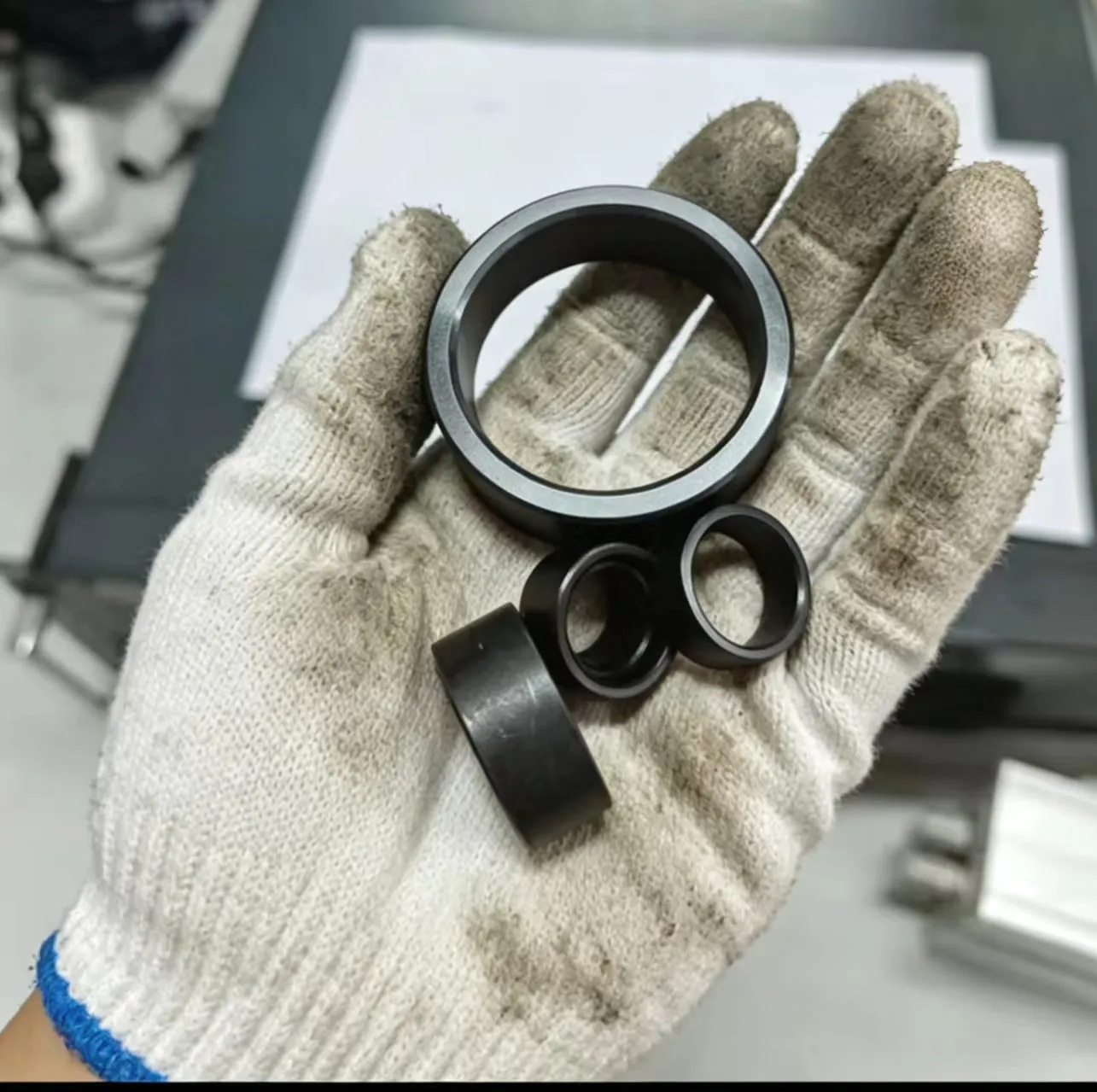
Product Showcase
Product Structure and Materials
The steel rod sleeve features a streamlined and compact design. The entire structure is engineered to ensure precise guidance, heavy-load support, wear resistance, and easy installation. While the components are simple, they are manufactured to strict tolerances. The core components include the sleeve body, precision inner diameter, mounting outer diameter, positioning step, and dust-proof groove (optional). These components work together to ensure precise fit and smooth guidance. Some high-end models can be equipped with auxiliary features such as oil grooves and lubrication holes. Detailed information is shown in the table below:
|
Structural Components |
Brief Introduction |
Core Requirements |
|
Sleeve Body |
As the core load-bearing and guiding component, it provides support and guidance for the rod, bears the load and impact force transmitted by the rod, and protects the rod from wear. |
High material strength, sufficient rigidity, uniform structural density, no distortion, cracking or deformation under long-term force, and excellent wear resistance. |
|
Precision Inner Diameter |
As the core matching structure, it fits closely with the optical rod and piston rod to realize guiding and limiting, control the matching gap, and reduce friction loss. |
Precise inner diameter tolerance, smooth surface without burrs or scratches, up-to-standard grinding precision, and no looseness or jamming when matching with the rod. |
|
Mounting Outer Diameter |
As the core structure matched with the equipment mounting seat and base, it realizes the fixed positioning of the sleeve and ensures the guiding precision. |
Precise outer diameter tolerance, close fit with the mounting seat without looseness, high coaxiality, and avoiding guiding deviation caused by sleeve offset. |
|
Positioning Step |
Used for positioning and limiting during sleeve installation to ensure accurate installation position of the sleeve, avoid excessive installation depth or offset, and ensure guiding coaxiality. |
Precise step size, flat end face, close fit with the mounting seat, firm positioning, and no hidden dangers of looseness or offset. |
|
Dust-proof Groove (Optional) |
Opened at the end of the sleeve, used with the dust-proof ring to prevent dust and impurities from entering the friction surface between the sleeve and the rod, and protect the matching surface. |
Precise groove size, suitable for the dust-proof ring, no burrs or deformation, effectively blocking impurities from entering without affecting the rod movement. |
In addition to the basic structure, high-end steel rod sleeves are equipped with oil grooves and lubrication holes to facilitate the application of grease, further reducing friction loss and enhancing wear resistance. Some split-type sleeves are equipped with locking screws to facilitate installation, disassembly, and fine-tuning of clearance, thereby improving guidance stability under harsh operating conditions.
Material selection directly determines the strength, rigidity, wear resistance, and suitability for specific operating conditions of steel rod sleeves. Significant performance differences exist among various steel grades, making material selection a critical aspect of the process. The characteristics of key materials and their recommended applications are as follows:
45# Carbon Steel: The industry's mainstream general-purpose material. After quenching and tempering, it achieves moderate hardness (HRC 28–35) and offers excellent machinability and outstanding cost-effectiveness. It is suitable for light to medium-duty applications and standard linear motion scenarios at room temperature in dry, non-corrosive environments. It is currently the most widely used material for steel rod sleeves.
GCr15 Bearing Steel: A high-strength, wear-resistant material. After quenching and tempering, it achieves a hardness of HRC 58–62. Its rigidity, impact resistance, and wear resistance are significantly superior to those of 45# carbon steel. It is suitable for heavy-duty, high-frequency reciprocating, and high-precision guidance applications.
304/316 Stainless Steel: A material with excellent corrosion resistance and high toughness, it is resistant to rust and oxidation, offers stable machining precision, and has moderate hardness (HRC 25–30). It is suitable for humid, mildly corrosive, and clean environments.
Additionally, alloy structural steel can be selected for special applications to further enhance strength and impact resistance; ordinary cast steel is low-cost but has poor precision and rigidity, making it suitable only for simple, low-precision, and light-load guidance scenarios, and it is rarely used in precision transmission fields. Surface treatments such as blackening, hard chrome plating, and zinc plating can be selected based on operating conditions to improve rust resistance and wear resistance.
Common Applications and Uses
Steel rod sleeves are specifically designed for heavy-duty, precision, and high-frequency linear motion applications. Any linear motion equipment requiring precise guidance, stable support, and load-bearing capacity utilizes steel rod sleeves, spanning industries such as machine tool manufacturing, industrial automation, hydraulics and pneumatics, construction machinery, and medical devices.
Machine tool manufacturing and precision machining are core application areas. Steel rod sleeves are used in the guide axes and feed axes of lathes, milling machines, grinding machines, and CNC machining centers. Thanks to their high precision and rigidity, they ensure precise guidance and stable support for guide axes, guaranteeing machining accuracy, reducing rod wear, and improving machine stability and service life.
In the fields of industrial automation equipment and linear motion, linear modules, slide cylinder assemblies, servo transfer mechanisms, and precision conveying equipment require precise guidance and high-frequency reciprocating motion. The high-precision fit and low-friction properties of steel rod sleeves ensure the straightness and positioning accuracy of rod movement, preventing equipment jamming or misalignment, and enhancing the operational efficiency and stability of automated systems.
In hydraulic and pneumatic systems, steel rod sleeves provide guidance and support for piston rods in hydraulic and pneumatic cylinders, withstanding high pressure and reciprocating loads. They effectively prevent uneven wear and bending of the piston rod, avoid hydraulic leaks, ensure the stable operation of hydraulic and pneumatic systems, and are suitable for various high-pressure, heavy-duty hydraulic equipment.
In construction machinery and heavy-duty equipment-such as cranes, lifts, hydraulic drilling rigs, and mining machinery-these guide sleeves serve as guide rods and support shafts, withstanding harsh operating conditions including heavy loads, impacts, and dust. The high strength, wear resistance, and impact resistance of steel guide sleeves enable them to withstand massive loads and impact forces, preventing deformation and excessive wear, and ensuring the long-term stable operation of construction machinery.
Additionally, they are widely used in medical devices, food processing machinery, outdoor equipment, power tools, and other applications. As core components for heavy-duty, precision guidance in linear transmission systems, they play an irreplaceable role in scenarios requiring both high guidance accuracy and load-bearing capacity.
Key Points of Precision Assembly
As the core component of precision transmission systems, steel rod sleeves require machining accuracy and fit tolerances at the micrometer level; careless assembly can easily cause irreversible damage and transmission failures. Assembly must strictly adhere to four key principles: coaxial alignment, gentle handling, non-destructive operations, and precise locking. These principles are broken down into a standardized four-step process to eliminate potential assembly deviations.
Preliminary Cleaning and Specification Verification: Clean the contact surfaces of the sleeve, mounting bracket, and rod to remove contaminants; verify dimensional compatibility, inspect for hidden damage in the sleeve, and ensure a unified assembly reference.
Coaxial Alignment and Insertion: Use precision alignment tools to calibrate coaxiality, and insert slowly to prevent damage; after insertion, use a dial indicator to verify that the positioning steps fit tightly.
Keyway Alignment and Precision Locking: Insert the key into the slot and ensure a tight fit; use a diagonal, staggered tightening method to secure the screws at the standard torque, preventing sleeve deformation.
Closed-Loop Assembly Verification: Test the rod's smoothness of movement and clearance; after confirming no abnormalities, apply a specialized lubricant to enhance wear resistance and service life.
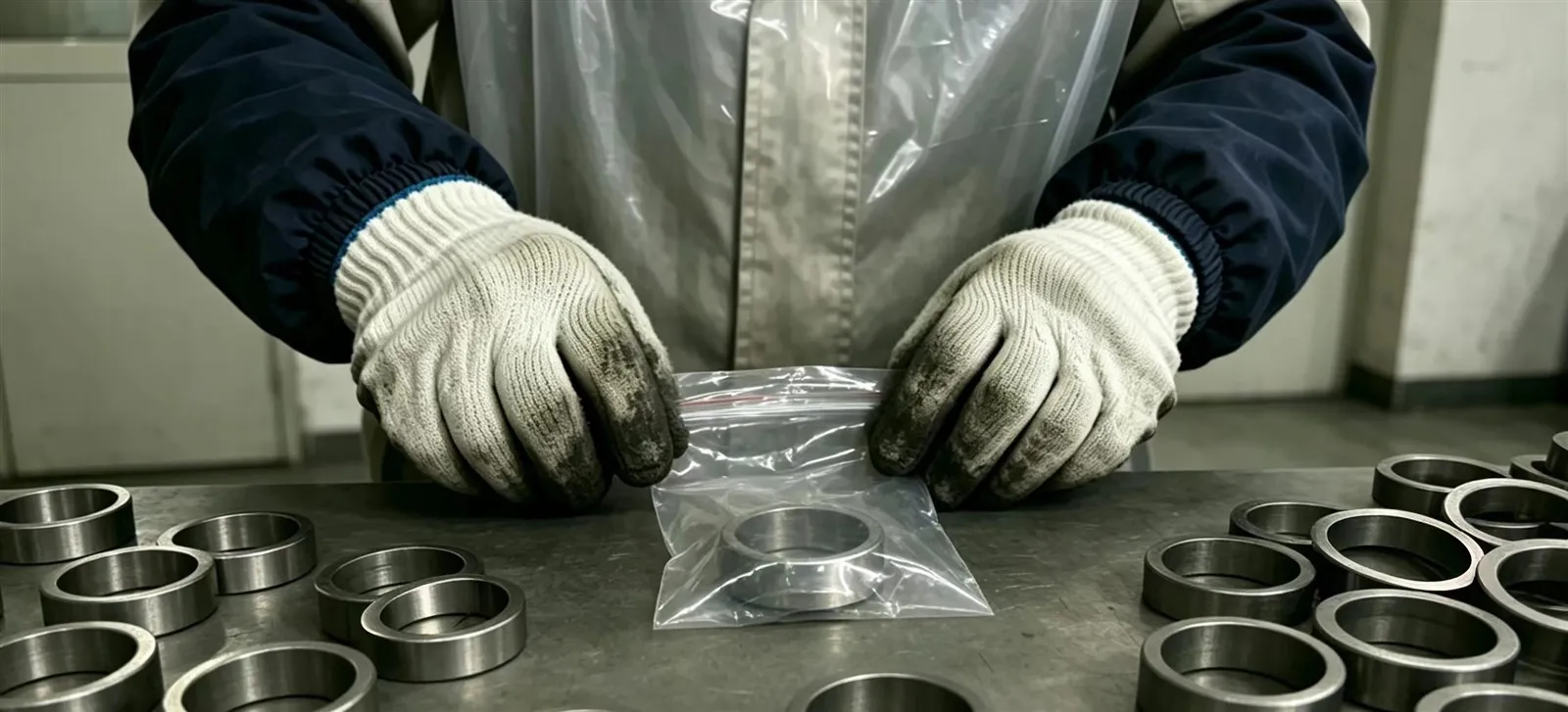
Product Packaging
Frequently Asked Questions (FAQ)
|
During the selection, installation, and use of steel rod sleeves, issues such as mismatched specifications, eccentric assembly, misalignment, and excessive wear often arise. Based on real-world application scenarios, we have compiled the eight most common and practical questions below, along with precise and easy-to-understand answers to facilitate daily use and troubleshooting: Q: Must steel rod sleeves match the dimensions of the bare rod or piston rod exactly? Can sleeves with similar dimensions be used interchangeably? A: They must match exactly; sleeves with similar dimensions cannot be used interchangeably. Mismatched inner and outer diameters will result in excessive or insufficient clearance. Excessive clearance can cause rod runout and misalignment, while insufficient clearance can lead to jamming and rod damage. Therefore, selection must strictly follow the rod's dimensions.
Q: Why does the rod exhibit jerking or make unusual noises during movement? How can this be resolved? A: There are three common causes: first, misalignment during assembly, where the sleeve and rod are not coaxial; second, excessive clearance, or burrs and scratches on the inner diameter; third, insufficient lubrication, resulting in excessive frictional resistance. Solutions: Re-align the coaxiality, grind down burrs on the inner diameter or replace the sleeve, and apply specialized grease.
Q: For heavy-duty, high-frequency reciprocating motion applications, which type of steel sleeve should be selected? A: GCr15 bearing steel is the preferred choice due to its high rigidity, impact resistance, and outstanding wear resistance. It can withstand heavy loads and high-frequency reciprocating motion without significant wear or deformation. If cost-effectiveness is a priority for medium to light-duty applications, quenched 45# carbon steel is a suitable alternative.
Q: Will steel rod sleeves rust in humid or slightly corrosive environments? How should they be protected? A: Ordinary carbon steel sleeves will rust. We recommend using 304/316 stainless steel, or carbon steel sleeves with hard chrome or zinc plating. Additionally, ensure proper equipment sealing to prevent prolonged exposure to moisture and corrosive media, and apply grease regularly.
Q: How should one choose between steel rod sleeves and copper alloy sleeves? A: For applications requiring high strength, high rigidity, and heavy-load capacity, select steel rod sleeves, which are suitable for precision and heavy-load scenarios. For applications requiring low friction, mild vibration damping, and lighter loads, select copper alloy sleeves, which are suitable for light-load, low-speed guidance scenarios. The two should not be used interchangeably without proper consideration.
Q: Can the sleeve still be used after the inner diameter has worn down? A: Continued use is not recommended. Inner diameter wear leads to excessive clearance, increased radial runout of the rod, reduced guiding accuracy, accelerated rod wear, and may even cause rod bending or equipment failure. The sleeve must be replaced promptly with one of the same specifications.
Q: What should be done if the sleeve fits too loosely or too tightly in the mounting seat during installation? A: A loose fit can cause the sleeve to shift and result in misalignment; replace it with a sleeve of larger outer diameter or use an interference fit. A tight fit can cause the sleeve to deform and reduce its inner diameter, potentially causing the rod to jam; replace it with a sleeve of the correct size. Never force it into place.
Q: How should steel rod sleeves be selected for high-temperature operating conditions (>80°C)? A: Prioritize GCr15 bearing steel, which offers superior high-temperature resistance and is less prone to thermal deformation. Additionally, use high-temperature-specific grease and increase the clearance (0.02–0.03 mm) to compensate for thermal expansion and contraction, thereby preventing jamming and wear caused by high temperatures. |
References
Specifications for Precision Machining and Assembly of Steel Shaft Sleeve. China Machinery Industry Standards Service Network
Technical Manual for Selecting Precision Guide Bushings. Chinese Society of Mechanical Engineers
Guide for Operating Condition Adaptation and Maintenance of Linear Transmission System Bushings. CNC Technology Network
Key Points on Structural Design and Material Application for Steel Guide Bushings. Industrial Control Network
Technical Data on Precision Inspection and Selection of Steel Bushings. Misumi Official Technical Documentation
Contact Us
📧 Email: lsjiesheng@gmail.com
🌐 Official website: https://www.automation-js.com/


