

"Why do linear guide shafts rust and experience operational jamming in humid conditions?""Why do guide shafts used outdoors frequently malfunction during rainy seasons?""How should guide shafts in high-humidity food processing environments be protected to prevent rust while meeting hygiene standards?" How can we protect guide shafts in high-humidity food processing workshops to prevent rust while meeting hygiene standards?" As an engineer specializing in linear transmission component R&D and application for 15 years, the core issue with these problems lies in: moisture and corrosive agents in humid environments directly damage the surface protective layer of linear guide shafts, accelerating wear and corrosion. This not only reduces transmission precision but also shortens service life by over 60%. In reality, protecting linear guide shafts in humid environments requires a systematic approach combining "material upgrades + sealing protection + lubrication adaptation + environmental control," not isolated measures. Today, we'll use an 4-step practical framework to demystify the core protection logic for linear guide shafts in humid conditions-from needs analysis to implementation-comprehensively addressing moisture protection challenges.
Step 1: 4-Step Practical Analysis of Moisture Protection Measures for Linear Guide Shafts
Define core protection requirements in humid environments-first understand "what to protect and why"
The need for humidity protection in linear guide shafts stems from "corrosion prevention, precision maintenance, and compliance requirements across diverse humid scenarios." Blindly implementing protective measures leads to ineffective results or wasted costs, as core demands vary significantly by scenario:
- Precision Transmission Scenario Core Requirement: Ultimate rust prevention + protection without compromising transmission accuracy, preventing moisture-induced precision drift. After implementing precise protective measures, 12 months of operation showed no corrosion and stable precision. Industry Standard: Per GB/T 30402-2013 "Linear Transmission Rolling Linear Guide Pairs," precision linear guide shafts in humid environments must ensure corrosion grade ≤ Grade 1.
- Core Requirements for Standard Industrial Settings: Basic rust prevention + stable operation. Balance protection effectiveness with cost to avoid excessive safeguards increasing investment. Blindly adopting high-end corrosion-resistant materials doubles the cost per guide shaft without practical necessity.
Key Requirements Confirmation: First identify the "humidity type," "precision grade requirements," and "scenario-specific constraints." Then set objectives based on "prioritizing core conflicts"-prioritize precision and micro-rust prevention in precision scenarios, prioritize strong rust prevention in harsh scenarios, and balance effectiveness and cost in standard scenarios.
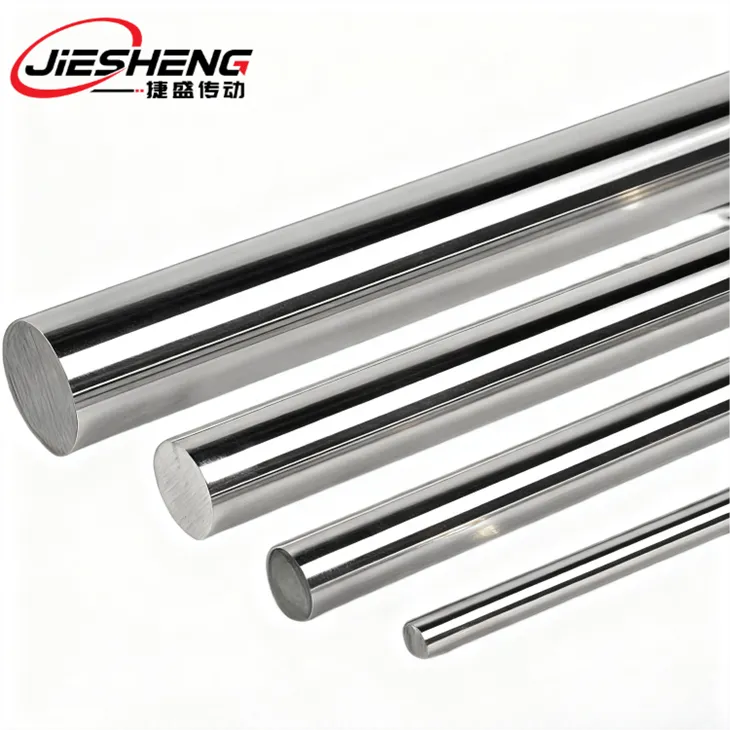
Step 2: Reinforce Sealing Protection Design-Block Moisture Invasion Pathways
Even with moisture-resistant materials, sealing designs must prevent moisture intrusion into critical areas like rolling elements and guide rail gaps. Three core sealing solutions adapt to different humidity scenarios:
- Basic Sealing Solution: Suitable for standard high-humidity environments, blocking atmospheric moisture and dust. Features an aging-resistant rubber seal ring. During installation, ensure the seal ring tightly adheres to the guide shaft surface with compression controlled between 0.3-0.5mm. Paired with a metal dust cover to prevent large particle contamination. Limitations: Cannot withstand liquid immersion or salt spray corrosion.
- Ultimate Sealing Solution: Suitable for extreme outdoor moisture conditions like rain exposure and immersion, completely blocking moisture ingress. Features a stainless steel fully enclosed housing with expansion seals at guide shaft movement points; all wiring and interfaces use waterproof connectors (IP68 rating) to eliminate any moisture pathways. Limitations: Complex structure increases guide shaft operational resistance, requiring higher drive power.
Sealing Rating Matching:
- Standard high-humidity environments: IP54 protection rating
- Salt spray/light rain exposure: IP65
- Extreme rain/immersion: IP68.
Step 3: Verify Compliance and Quality of Protection Solutions-Ensure Performance and Safety Standards
Substandard protective materials or non-compliant solutions may lead to protection failure or even safety hazards. Reliable solutions must be selected through compliance verification and quality testing:
- Material Compliance Verification: Seals, grease, and other materials must meet application standards. Food-grade applications require NSF H1-certified grease and food-grade rubber seals; explosion-proof applications require Ex d IIB T4 Ga-certified monitoring equipment.
- Batch Application Sampling Verification: For bulk-purchased guide shafts and protective components, conduct random inspections on 5%-10% of the batch. Verify material composition, sealing performance, and grease quality. Reject the entire batch if any single criterion fails.

Step 4: Control Protection Costs-Precise Investment, No Wasteful Spending
The moisture protection costs for linear guide shafts encompass material procurement, equipment installation, and maintenance expenses. A balance between effectiveness and cost is essential. Two optimization strategies yield significant results:
- Select based on requirements to avoid overprotection: For standard high-humidity environments, use the "carbon steel + hard chrome plating + basic seal + standard grease" solution, keeping per-shaft protection costs between ¥200-500 while fully meeting requirements. For precision environments, upgrade to "316L stainless steel + precision dehumidification + specialized grease." For extreme environments, implement the "full-envelope seal + titanium alloy material" solution.
Conclusion: Moisture Protection for Linear Guide Shafts - "Systemic Protection + Precise Adaptation, Long-Term Stability Without Waste"
Protecting linear guide shafts in humid environments requires not a "single measure," but a systemic solution encompassing "material selection + sealing protection + lubrication adaptation + environmental control + routine maintenance." The core logic is "multi-dimensional coordination to block moisture hazards at the source while balancing precision retention and cost control.".
Contact Us
📧 Email: lsjiesheng@gmail.com
🌐 Official website: https://www.automation-js.com/


