

Hey! Many assembly technicians struggle when choosing Linear Guide Shafts: plain shafts and ball spline shafts look similar, but their applications differ greatly. Picking the wrong one can easily lead to jamming or wear. Different guide shafts emphasize distinct structures, performance characteristics, and compatibility scenarios-choosing the right one ensures durability. Today, we'll break down the differences between common types and the selection process in plain language, helping you match them precisely to your application and avoid unnecessary detours.
First, clarify: 2 core concepts to avoid selection traps
Don't pick guide shafts based on gut feeling. First, correct two common misconceptions and understand their core functions to select accurately and ensure longevity.
Misconception 1: No "universal guide shaft" exists-focus solely on application compatibility
The core function of a guide shaft is to drive components in linear motion while bearing loads and maintaining precision. However, load capacity and precision grades vary drastically between models-never interchange them arbitrarily. Align selection with your equipment's operational conditions: Is it for light-load high-speed operation or heavy-load low-speed tasks? Does it require simultaneous rotation and straight-line movement? Identifying the right application scenario ensures stable, fault-free operation.
Misconception 2: Differences lie not in appearance but in internal structure
Many assume any round shaft is interchangeable, yet their internal designs vary dramatically. Plain shafts rely solely on sleeve fits-simple but insufficient for high precision. Ball spline shafts incorporate internal balls, enabling both linear positioning and synchronous rotation. Selecting based on appearance alone risks precision failures at best and equipment wear at worst, leading to costly repairs and material waste.
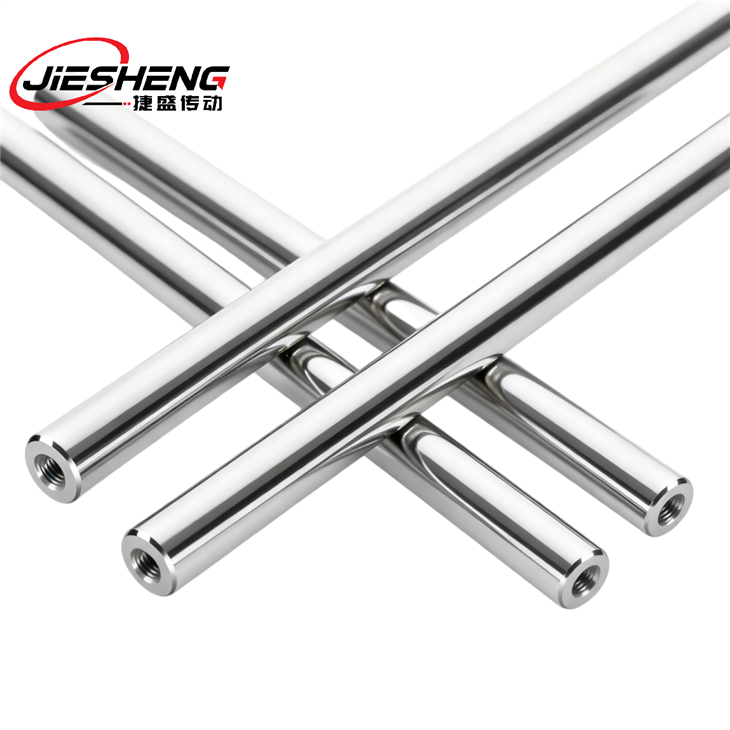
Core Differences: 4 Mainstream Types for Need-Based Selection Without Pitfalls
The four common types of Linear Guide Shafts on the market each suit specific operating conditions. There is no absolute superiority; identifying equipment requirements ensures proper selection and avoids future failures.
First: Solid Shafts – Essential Basics, Top Choice for Light-Load General Applications
Solid shafts are precision-ground solid round shafts requiring linear bearings or bushings for use. They represent the most fundamental and versatile guiding components in assembly.
Advantages: Exceptional cost-effectiveness with low procurement and machining costs. Installation requires no precise calibration-simply wipe clean and reapply lubrication regularly. Quick replacement minimizes production downtime.
Limitations: Only suitable for basic guidance tasks. Weak axial load capacity; prone to slippage at high speeds. Cannot withstand impact or off-center loads. Inadequate for precision-critical applications.
Suitable Scenarios: Standard conveyor tables, manual fixtures, small equipment push/pull mechanisms, and light-load components without stringent precision requirements.
Second, Ball Spline Shaft: Specialized for Compound Motion, Suitable for High-Precision Applications
Core feature: The shaft's spline grooves engage with embedded balls to enable simultaneous linear and rotational motion without additional transmission components.
Advantages: High motion precision, low friction resistance, capable of bearing combined radial and axial loads, precise positioning, suitable for equipment requiring high motion coordination.
Limitations: Demands extremely high installation precision; spline grooves prone to dust accumulation and jamming, requiring regular cleaning and lubrication. Cost is 3-5 times that of plain shafts, making it unnecessary for ordinary applications.
Suitable Applications: Industrial robot joints, CNC machine tool tool magazines, precision inspection equipment probes, automated actuators requiring simultaneous rotation and linear motion.
Third, Linear Guide Shafts: Heavy-Duty Precision Champions for Stability-Priority Applications
Requires use with linear guide rails as a complete set. The shaft is the core component guiding the rail, featuring an internal ball or roller recirculation mechanism. It enables high-precision linear reciprocating motion with maximum positioning stability.
Advantages: Maximum load capacity, capable of withstanding overturning loads without deviation. Achieves micron-level motion accuracy. Operates smoothly without play or abnormal noise under high-speed, heavy-load conditions. Service life far exceeds standard guide shafts.
Limitations: High overall cost, requires professional calibration for installation, demands stringent environmental conditions, necessitates dust protection and lubrication systems, with significant maintenance complexity and expense.
Suitable Applications: Precision machining centers, CNC machine tool guides, high-end automated production lines, heavy-duty material handling machinery, precision positioning mechanisms for electronic equipment.
Fourth, Hollow Guide Shafts: Specialized Layout Adaptation, Preferred Choice for Lightweighting
Featuring a hollow shaft structure resembling solid shafts in appearance, these require dedicated hollow shaft bearings. They primarily address lightweighting and pipeline routing challenges.
Advantages: Weight is only 60% of equivalent solid shafts. Hollow cavities allow routing of wires and air tubes, saving internal equipment space and reducing drive energy consumption.
Limitations: Insufficient rigidity, weaker torsional resistance and load capacity than solid shafts. Prone to deformation during high-speed operation. Prohibited for heavy-load, high-precision, or high-impact applications.
Suitable Applications: Compact lightweight robotic arms, medical devices, components requiring tight internal equipment layouts, moving mechanisms needing conduit routing, and low-pressure conveying equipment.
Selection Comparison: Core Differences at a Glance
For intuitive comparison, key parameters are summarized below to facilitate rapid selection:
|
Type of Linear Guide Shaft |
Motion Precision |
Load-Carrying Capacity |
Core Advantages |
Applicable Scenarios |
|
Smooth Shaft |
Medium |
Light Load Mainly |
Simple Structure, Low Cost, Easy Maintenance |
General Light-Load Guidance, Simple Equipment |
|
Ball Spline Shaft |
High |
Medium to Heavy Load |
Combines Linear & Rotational Motion, High Precision |
Compound Motion, Precision Equipment |
|
Linear Slide Shaft |
Extremely High |
Heavy Load, Anti-Tipping |
Strong Stability, Long Service Life |
High-Precision Machining, Heavy-Load Equipment |
|
Hollow Guide Shaft |
Medium |
Light Load |
Lightweight, Cable/Pipeline Passable |
Compact Layout, Lightweight Equipment |
Essential Post-Selection Checks: Ensuring Safe Compatibility
After selecting the guide shaft, perform these checks before installation and during trial operation to prevent failure risks from selection errors or installation issues:
Precision Check: Manually push the guide component. Movement should be smooth without stuttering or misalignment. After positioning, no noticeable looseness should be present, meeting the equipment's precision requirements.
Load Compatibility Check: Apply corresponding loads during trial operation. The guide shaft should show no deformation or abnormal noise, with load capacity matching equipment requirements.
Environmental Compatibility Check: Verify the guide shaft material and protective structure suit the operating environment. Implement corresponding protective measures for high-temperature or dusty conditions.
Avoid Pitfalls: Steer Clear of 3 Common Selection Errors
When selecting Linear Guide Shafts, focus on these three key points to prevent selection errors and reduce future failures:
Avoid Blindly Pursuing High Precision: Selecting linear guide rails for ordinary light-load scenarios is pure overkill, increasing costs. Selecting hollow shafts for high-precision applications may result in insufficient accuracy.
Do not overlook composite requirements: When both linear and rotational motion are required, hollow shafts or Linear Guide Shafts cannot meet the demand. Prioritize ball spline shafts.
Do not underestimate environmental impacts: Unprotected ball spline shafts or Linear Guide Shafts in dusty or high-temperature environments are prone to internal wear and jamming. Protective structures must be integrated.
Summary
The core distinction among Linear Guide Shaft types fundamentally lies in structure dictating performance and performance matching application scenarios. Hollow shafts excel in cost-effectiveness, ball spline shafts dominate in compound motion, linear guide rails shine in high-precision heavy-load applications, while hollow guide shafts suit lightweight requirements.
Contact Us
📧 Email: lsjiesheng@gmail.com
🌐 Official website: https://www.automation-js.com/


