

How to improve the positioning accuracy of ball screws?
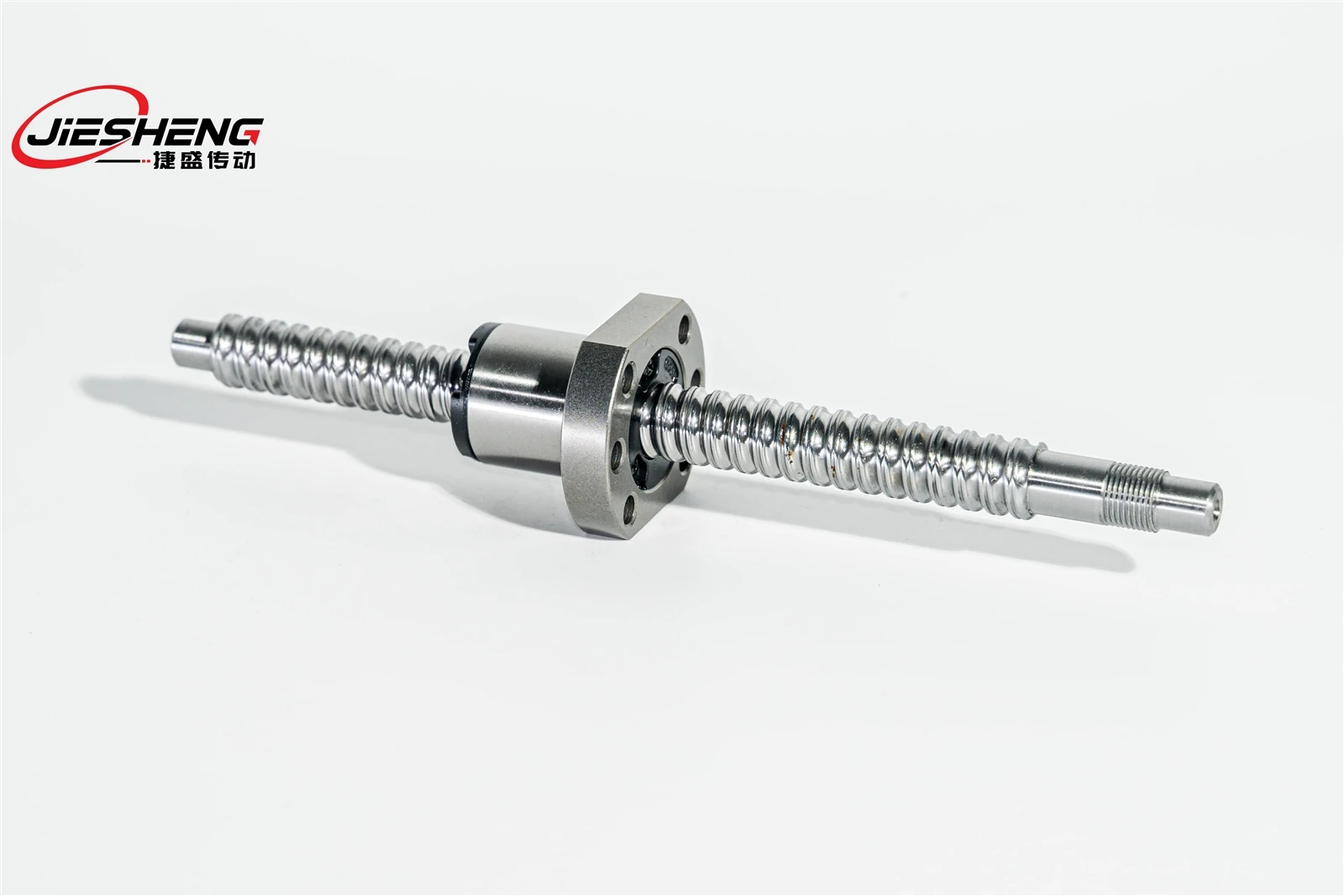
First, the basic knowledge of the positioning accuracy of ball screws
(I) Definition of Positioning Accuracy
The positioning accuracy of Ball Screw refers to its ability to move the moving parts along the axis to the target position precisely, which is usually measured by the deviation value between the actual displacement and the theoretical displacement, and the unit is micrometer (μm). In high-precision scenarios (e.g., photolithography, coordinate measuring machines), the positioning accuracy requirements are extremely high and need to be controlled within ±5μm or even higher.
(2) Core Influencing Factors
Mechanical design elements
Lead accuracy: the pitch error of the ball screw will directly affect the positioning accuracy, and the pitch error of precision grade products can be controlled in a small range.
Pre-tensioning design: Insufficient pre-tensioning will lead to empty travel during reverse movement, while excessive pre-tensioning may increase friction heat.
Ball and raceway matching: The consistency of the ball diameter and the smoothness of the raceway surface (low roughness) are critical to smooth motion.
Mounting and support structure
Coaxiality deviation: Excessive error in the coaxiality of the screw axis with the motor axis and guideway may generate additional torque and lead to positioning deviation.
Support rigidity: Insufficient rigidity of the fixed end bearing can easily cause axial vibration.
Load and Motion Characteristics
Inertia Matching: Mismatch between load inertia and screw inertia may lead to overshoot or oscillation during start and stop.
Speed and Acceleration: When running at high speed, the screw may affect positioning accuracy due to thermal expansion.
Environmental and Control Factors
Temperature Changes: Increased temperatures can cause steel screws to expand, resulting in positioning errors.
Control system response: Closed-loop control (with scale feedback) is more effective in correcting system errors than open-loop control.
Second, the key strategy to improve positioning accuracy
1. Accurate selection: matching the application requirements of the parameters of the screw.
Prioritize precision level: choose the appropriate precision level according to the application scenario, such as precision level for CNC machine tools, semiconductor equipment, ultra-precision level for high-precision measuring instruments, etc.
Optimization of lead and diameter: small lead screws can be selected for high-precision scenarios to reduce the unit displacement error; large-diameter screws are used for large-load scenarios to reduce elastic deformation.
Pre-tensioning: Double-nut pre-tensioning can effectively control the backlash (within 5μm), which is suitable for the scenarios with high precision requirements; single-nut self-pre-tensioning is suitable for the cases with space constraints.
Supplier's suggestion: Provide a full range of ballscrews with different accuracy levels, supporting customized guidance, preload and surface treatment (such as hard chrome plating, nitriding) to meet different accuracy requirements.
2. Precision mounting: the core of eliminating mechanical errors.
Coaxiality calibration: professional tools are used to test the coaxiality of the screw and motor shaft to control the error within a very small range (e.g., within 0.01mm), and the support base adopts a reliable positioning method to ensure the unity of the installation reference.
Reinforcement of support structure: high rigidity bearing set is used for the fixed end, and the intermediate support seat should be added for long screws to reduce sagging.
Anti-loosening and lubrication: The mounting screws should be fastened according to specifications and anti-loosening measures should be adopted, and suitable grease should be applied regularly to reduce the friction coefficient.
3. Load and motion control optimization
Matching of inertia: Ensure a reasonable ratio between load inertia and screw inertia, high-speed scenarios can be configured with speed reducers to reduce the impact of load inertia.
Acceleration and deceleration curve optimization: adopt smooth acceleration and deceleration algorithm (such as S-curve) to avoid impact peaks, and the servo system can be set up with feed-forward compensation to reduce tracking error.
Dynamic load compensation: real-time monitoring of load changes through force sensors to adjust the driving torque; gravity load scenarios can be configured with a balancing device.
4. Environmental control and thermal management
Temperature stabilization solution: use the screw in a constant temperature environment, the hollow structure can be used to control the temperature through the coolant; choose low expansion materials (such as ceramic ball, granite base) to reduce thermal deformation.
Vibration isolation: the equipment base adopts vibration isolation pads, away from the source of vibration, and the screw can be equipped with anti-vibration jacket to attenuate the vibration.
5. Life cycle maintenance strategy
Regular accuracy testing: Use professional equipment to test the positioning accuracy every year, record the error trend, and investigate the abnormality in time.
Wear warning and repair: monitor the backlash changes, minor wear can be repaired by grinding, severe wear requires replacement of parts.
Third, the conclusion
Enhancing the positioning accuracy of ball screws requires comprehensive optimization from multiple aspects such as selection, installation, control, environment, maintenance, etc., with particular attention to mechanical accuracy and thermal deformation control. As a professional supplier, we can provide full-process services from parameter design, installation guidance to troubleshooting to help maximize the performance of precision drive systems.
For more information about high precision ball screws or customized solutions, please feel free to contact us and we look forward to providing technical support!

Contact Us
📞 Phone: +86-8613116375959
📧 E-mail: 741097243@qq.com
🌐 Official website: https://www.automation-js.com/


