

"Why does the linear shaft in precision linear modules frequently jam? Is it due to an insufficient precision grade during selection or incompatible materials?""Under high-load conditions, which structural design of precision linear shaft should be chosen to prevent deformation?""In humid and corrosive environments, how can protection and selection of precision linear shafts be balanced?" As an engineer with 12 years of expertise in precision transmission component selection and application technology, the core of these questions lies in "accurately matching operational requirements with the core characteristics of linear shafts." As a core component in automation equipment, precision machine tools, medical devices, and electronic processing equipment, precision linear shafts play a critical role in guiding positioning, bearing loads, and ensuring motion accuracy. Their proper selection directly determines the operational stability, positioning accuracy, and service life of the equipment. Inappropriate selection may lead to positioning deviations exceeding tolerances and premature component failure. Conversely, precise selection can elevate equipment operational stability to 99.6% and extend linear shaft service life beyond 10,000 hours. Today, we present an 7-step framework to comprehensively master precision linear shaft selection methods-from foundational principles to practical validation-clarifying "what defines core selection criteria, how to choose based on specific scenarios, and key considerations."
Step 1: Comprehensive Analysis of the 7-Step Precision Linear Shaft Selection Process
Define the Core Selection Principles - First, understand "What is the core of precision linear shaft selection?"
To accurately master precision linear shaft selection methods, first clarify the core concepts, objectives, and constraints of selection to avoid confusion with standard linear shaft selection:
- Core Definition: Precision linear shaft selection is a systematic decision-making process that evaluates equipment operating conditions and motion characteristics against core parameters like structural type, material properties, and accuracy grades to identify products meeting requirements for "precise guidance, stable load-bearing, and long-term reliability." This fundamentally differs from standard linear shaft selection-it prioritizes "precision stability" and "operating condition adaptability," focusing on resolving issues like positioning deviation, load deformation, and environmental corrosion in precision applications.
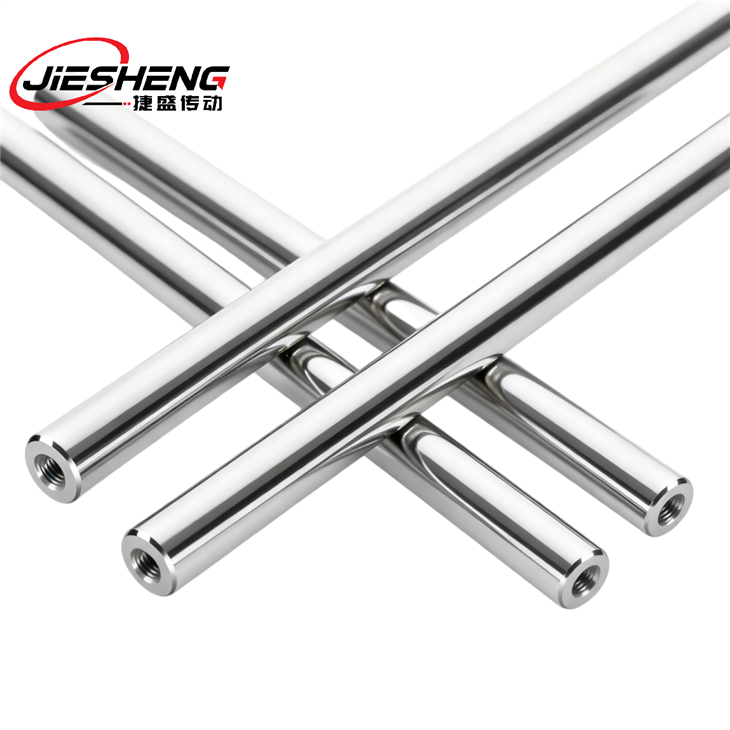
Step 2: Pre-Selection Preparation-Clarify Operating Conditions to Avoid Blind Selection
Thorough preparation before selecting precision linear shafts is fundamental to ensuring accurate selection. The core approach is to "define equipment operating conditions, outline core requirements, and verify installation conditions" to prevent selection errors caused by ambiguous needs:
Define Core Operating Parameters:
- Load Parameters: Determine axial load, radial load, and combined load magnitude (unit: N) during operation.
Install and usage requirements:
- Installation space: Specify linear shaft installation length and diameter constraints (unit: mm), presence of confined installation areas;
- Lubrication requirements: Permissibility of periodic lubrication, need for oil-free lubrication;
- Maintenance requirements: Equipment maintenance cycle requirements; whether low-maintenance or maintenance-free operation is required;
- Service life: Expected linear shaft service life.
Step 3: Selecting Application-Specific Solutions Based on Scenarios - Different Operating Conditions Require Different Selection Priorities
Precision Machine Tool Applications:
- Core Requirements: High-precision guidance, high wear resistance, high load capacity;
- Recommended Solution: Ball Screw Shaft/Ball Spline Shaft + Bearing Steel Material + High Precision h5-h6 + Nitriding Treatment;
Electronic Processing/Semiconductor Applications:
- Solution: Hydrostatic linear shafts/high-precision ball linear shafts + bearing steel/ceramic materials + ultra-high precision h3-h4 + nitriding treatment.
Medical Device Applications:
- Core Requirements: High hygiene standards, corrosion resistance, low noise, high precision;
- Recommended Solution: Ball Linear Shaft + SUS316 Stainless Steel Material + High Precision h5 + Chrome Plating/PTFE Coating;
Harsh Corrosive Environments:
- Core Requirements: Strong corrosion resistance, wear resistance;
- Solution: Ball linear shaft + SUS316 stainless steel/ceramic material + High precision h6 + Ceramic coating/PTFE coating.
Step 4: Critical Parameter Calculation for Selection - Quantitatively Validate Selection Rationality
Precision linear shaft selection requires quantitative parameter verification to prevent failure due to mismatched specifications. Three core parameters must be validated:
Load Calculation:
- Logic: Rated dynamic load ≥ Actual working load × Impact factor (1.2–1.5); Rated static load ≥ Actual working load × Safety factor (2–3);
Service Life Calculation:
- Formula (Ball Linear Shaft): L10 = (C/Pr)³ × 10⁶ (Unit: m); where L10 is rated life (km), C is rated dynamic load (N), and Pr is equivalent dynamic load (N);
- Verification requirement: Calculated service life must ≥ expected equipment lifespan; if not met, upgrade linear shaft specifications or change structural type;
Accuracy margin calculation:
- Calculation logic: Straightness and parallelism errors of selected linear shaft ≤ 1/3–1/2 of equipment positioning accuracy requirements, reserving accuracy margin to prevent degradation due to installation or wear.
Step 5: Common Pitfalls in Selection and How to Avoid Them-Precision Pitfall Avoidance to Boost Selection Success Rate
During precision linear shaft selection, common pitfalls include "excessive precision," "neglecting operational matching," and "cost escalation." Practical experience is essential to precisely avoid these:
Pitfall 1: Blind pursuit of high precision leads to cost waste;
- Manifestation: Selecting ultra-high-precision linear shafts for standard automation equipment, increasing procurement costs by 3-5 times;
- Avoidance Method: Match precision grades to the positioning accuracy requirements of the equipment. Use standard precision for ordinary equipment and high precision for precision equipment; avoid unnecessary upgrades.
Misconception 2: Focusing solely on precision while neglecting load matching;
- Manifestation: Selecting high-precision linear axes with insufficient rated load capacity, resulting in shaft deformation and ball wear during operation;
- Mitigation: First calculate load requirements to ensure the linear axis's rated dynamic and static load capacities meet operational conditions, then match the precision grade.

Step 6: Post-Selection Verification and Optimization-Ensuring Feasibility of Selection
After selecting precision linear guides, validate the selection through sample testing and parameter review to prevent issues after bulk procurement:
Sample Testing Verification:
- Test Items: After installing samples, test equipment positioning accuracy, repeatability, and operational stability. Measure linear guide noise and temperature (≤ ambient temperature +40°C).
- Testing Standards: All parameters must meet equipment design requirements with vibration-free and noise-free operation.
Parameter Verification:
- Verification Items: Recheck alignment of linear shaft parameters (structural type, material, accuracy grade, rated load) with operational conditions to ensure no omissions.
- Verification Method: Compare product manuals with selection requirement lists, cross-checking parameters item by item;
Optimization Adjustments:
- If sample testing fails precision requirements: Upgrade precision grade or change structural type;
- If excessive operational noise/temperature occurs: Adjust lubrication method or change surface treatment type;
- If load capacity is insufficient: Upgrade linear shaft specifications or switch to high-load structural type.
Step 7: Cost Control in Selection - Balancing Performance and Cost for Efficient Selection
Precision linear shaft selection requires reasonable cost control while meeting performance requirements, avoiding overinvestment or cost shortfalls. Two optimization strategies yield significant results:
Precise Selection to Avoid Performance Redundancy:
- Standard Conditions: Use plain shaft + bearing steel + standard precision, controlling costs at 50-200 RMB/meter;
- Precision applications: Select ball linear shafts + bearing steel + high precision, controlling costs at 200-800 RMB/meter;
- Ultra-precision applications: Use hydrostatic linear shafts + special materials only when necessary, controlling costs at 2000-5000 RMB/meter.
Conclusion: Precision Linear Guide Selection - "Precise Matching to Operating Conditions, Full-Process Quantitative Control"
The core logic of precision linear guide selection is "Operating Requirements → Core Parameters → Dimensional Matching → Quantitative Calculation → Verification & Optimization → Cost Balancing." Its essence lies in achieving the optimal combination of guiding accuracy, load capacity, service life, and cost within operating constraints. Key control priorities vary by application: standard scenarios emphasize "low cost + basic performance," precision scenarios prioritize "high accuracy + high wear resistance," while harsh environments demand "strong adaptability + high reliability."
Common user pitfalls include: "blind pursuit of high precision leading to cost waste," "neglecting operational conditions when matching materials/surface treatments," "failing to quantify parameters resulting in selection failure," and "overlooking long-term maintenance costs." In practice, following the 7-step approach outlined in this article enables precise selection: First, clarify equipment operating conditions and core requirements. Then, precisely match components across four dimensions-structural type, material, accuracy grade, and surface treatment. Validate rationality through quantitative calculations of load capacity, service life, and accuracy margin to avoid common selection pitfalls. Finally, ensure implementation through sample testing and cost optimization. This process achieves accurate selection of precision linear shafts.
Contact Us
📧 Email: lsjiesheng@gmail.com
🌐 Official website: https://www.automation-js.com/


