

"Can standard steel bushings not fit irregular installation spaces?" "Under special operating conditions, material, precision, and structure all require adjustments, but where to start?" As engineers with 15 years of experience in mechanical component customization and precision machining, such customization dilemmas are extremely common. The core issue often stems from insufficient understanding of the customization scope, compatibility logic, and key control points for steel bushings. As core support components in mechanical transmission systems, steel bushings are widely used in construction machinery, automation equipment, new energy installations, and more. However, load capacities, environmental conditions, and installation spaces vary significantly across different applications, leading to common issues with standard bushings such as poor adaptability and susceptibility to failure. A new energy equipment manufacturer once faced installation space constraints. After selecting a standard steel bushing that proved unfit for assembly, they resorted to customizing a non-standard structural bushing to resolve the issue. However, due to unclear customization parameters in the initial phase, repeated modifications caused a 30-day project delay, resulting in direct losses exceeding 50,000 yuan. In reality, steel bushing customization options span multiple dimensions including material, dimensions, structure, and manufacturing processes. The key lies in precisely defining requirements based on operating conditions and meticulously controlling customization details. Today, we'll guide you through an eight-step framework to master core customization options for steel bushings-from requirement analysis to delivery verification-addressing pain points like directionless customization, common pitfalls, and poor compatibility.
Step 1: Practical 5-Step Analysis of Steel Bushing Customization
Define Core Customization Prerequisites-First Understand "Requirement Boundaries and Acceptance Thresholds"
To precisely determine customization options for steel bushings, first clarify the core requirements of the application scenario, the boundaries of customization, and industry-standard qualification thresholds. This prevents "blind customization" that leads to soaring costs or failed compatibility:
The core prerequisites for steel bushing customization can be summarized in three points: First, match specific operating conditions to address issues like corrosion, heavy loads, high frequencies, and irregular spaces that standard products cannot accommodate; Second, ensuring performance compliance with core metrics like load capacity, wear resistance, and precision after customization. Third, balancing cost and lead time by managing customization complexity against economic viability. Key customization dimensions include: material grade, dimensional specifications, fit accuracy, structural design, surface treatment, lubrication method, sealing protection, and inspection requirements.

Step 2: Core Customization Options and Risks for Steel Bushings-Quantitative Analysis for Precise Mitigation
Customization options for steel bushings require dialectical selection based on operating conditions. It is essential to clarify the suitability value of each option while precisely mitigating failure risks caused by improper customization, balancing benefits and costs:
Dimension & Precision Customization:
Adapted for irregular spaces and precision transmission. Dimensional tolerances customizable to ±0.002mm, surface roughness Ra≤0.2μm, achieving 40% higher precision than standard products.
Structural Customization:
Optimized oil grooves, chamfers, steps, and openings enhance lubrication and installation compatibility. Examples include spiral oil grooves reducing high-frequency wear and stepped structures enabling precise positioning.
- Potential Customization Risks (Hazards of Improper Customization):
Material Selection Errors (30% impact weight): Custom materials mismatched with operating conditions-using ordinary carbon steel in corrosive environments yields an 85% failure rate;
Unreasonable structural design (25% impact weight): Overly complex structures drastically increase machining difficulty and double costs, or create stress concentrations prone to fracture;
Excessive precision requirements (20% impact weight): Precision exceeding machining capabilities causes project delays and 3-5x cost increases, while actual operating conditions rarely demand such high precision.
Step 3: Material and Heat Treatment Customization-Tailored to Core Operating Requirements
Material selection and heat treatment form the foundation of steel bushing customization. Precise material grades and heat treatment processes must be chosen based on operating conditions such as corrosion, temperature, and load. The core principle is "performance first, cost-appropriate":
- Customizable heat treatment processes:
Heavy-duty wear resistance: Custom "quenching + tempering" process elevates hardness to HRC 35-40, tensile strength ≥900 MPa;
Precision applications: Custom "normalizing treatment" enhances material uniformity and toughness while minimizing machining deformation;
Low-temperature scenarios: Custom "low-temperature tempering" boosts low-temperature toughness, preventing brittle fracture at -40°C.
Step 4: Customize Lubrication Methods & Inspection Requirements-Ensure Long-Term Stable Operation
Customize lubrication methods and inspection requirements based on operational demands to guarantee smooth bearing operation while controlling quality through precise inspection:
- Inspection Frequency & Standards:
Custom orders ≤50 pieces: 100% inspection;
Batches >50 pieces: Sampling inspection (≥10% sample rate);
Critical equipment custom parts: Full inspection + third-party test reports.
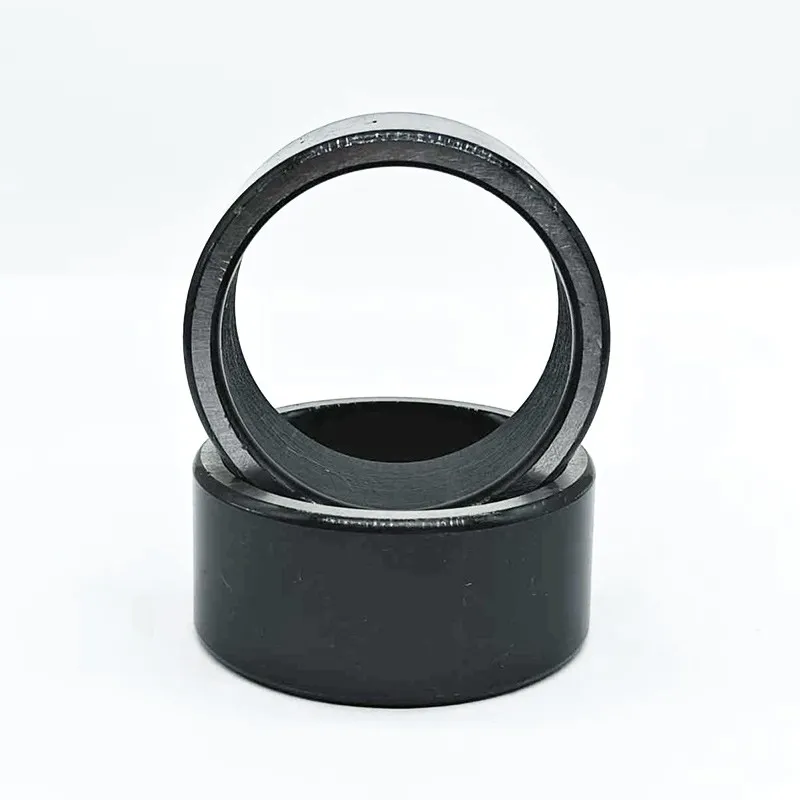
Step 5: Customized Process & Delivery Verification-Controlling Quality & Timelines
Standardized custom processes and rigorous delivery verification are key to ensuring qualified steel bushing customization, centered on "closed-loop processes and controllable quality":
- Custom Process Specifications:
Requirement Communication: Define operating conditions, custom options, performance requirements, cost, and timeline;
Solution Design: Provide 3D drawings, material specifications, and process plans; initiate production upon confirmation;
Prototype Testing: Small-batch trial production (1-3 pieces) with preliminary inspection and trial operation;
Batch Production: Mass production after prototype approval with in-process sampling;
Delivery Acceptance: Provide inspection reports and certificates for final acceptance.
Conclusion: Customization hinges on precise alignment; end-to-end process control is paramount.
In summary, customization options for steel bushings span materials, dimensions, structures, processes, lubrication, and testing. The core logic follows: "Operating Conditions → Option Matching → Solution Design → Sample Validation → Batch Delivery." This ensures customized products align with specific scenarios while meeting performance and cost requirements.
Common user pitfalls include:
- Blind pursuit of exhaustive customization options
- Neglecting compatibility between operating conditions and options
- Omitting sample testing and validation
These lead to failed custom products, cost overruns, and schedule delays.
In practice, the process should be:
- Define requirement boundaries → Precisely match custom options → overlooking compatibility between operating conditions and options," and "omitting sample prototyping and testing." This leads to product failure, cost overruns, and delivery delays.
Contact Us
📧 Email: 741097243@qq.com
🌐 Official website: https://www.automation-js.com/


