

In heavy-duty fans and pumps, heavy-load belt conveyor lines, fine crushing equipment in mines, the drive end of extruders, auxiliary machinery in metallurgy, the input and output ends of high-power gear reducers-standard star couplings, small diaphragm couplings, and rigid flange couplings generally suffer from structural shortcomings such as insufficient allowable torque, weak impact resistance, inadequate misalignment compensation, and rapid fatigue failure of elastic elements. Extensive on-site maintenance statistics show that when ordinary small- and medium-sized star couplings are subjected to impact loads exceeding 1.3 times the rated torque, the polyurethane elastomer undergoes compression creep, leading to fragmentation and failure after 300–800 hours of operation; Rigid flange couplings have no displacement compensation capability whatsoever; even a 0.15 mm radial misalignment caused by settlement of the motor and load bases can lead to a sharp increase in additional loads on the motor and reducer bearings, resulting in a 25–40 °C rise in bearing temperature and a reduction in bearing life of more than 60%; In standard elastic pin couplings, the nylon pins experience accelerated wear under alternating impact conditions, causing the amplitude of operational vibration to gradually increase by 2–4 times, resulting in abnormal coupling noise, keyway wear, and power transmission loss; Some low-quality heavy-duty flexible couplings are not subjected to tempering treatment, resulting in stress concentration at the keyway of the half-coupling hub. Under frequent start-stop conditions, this leads to hub cracking, causing unplanned downtime for the entire production line.
High-torque flexible couplings are designed for heavy-duty, impact-prone applications. They are flexible transmission components that rely on the deformation of elastic elements to transmit torque while providing three-directional displacement compensation and vibration damping. The mainstream product lines include heavy-duty claw-type star couplings, serpentine spring couplings, tire-type, and large-size diaphragm types. Their nominal torque ranges from 250 to 50,000 N·m. Connection methods include keyway connections, clamping and locking, and expansion sleeve couplings. Dynamic balance grades are classified into two levels: standard grade G12.5 and precision grade G6.3. The main hub is forged from high-quality alloy steel and then normalized and tempered. The elastic elements are made from a variety of materials, including polyurethane, alloy spring steel, vulcanized rubber, and stainless steel diaphragms. While transmitting high torque, they compensate for combined radial, angular, and axial misalignments caused by installation, thermal deformation, and frame settlement; absorb start-stop impacts and alternating load vibrations; and prevent failures such as bearing overload, keyway damage, and excessive machine vibration that result from rigid transmission. Combining high load-carrying capacity, misalignment compensation, and damping/vibration reduction, these couplings are widely used in heavy-duty transmission applications such as high-power pump sets, mining conveyors, extrusion equipment, metallurgical auxiliary machinery, and heavy-duty automated production lines. Based on the national standards GB/T 5272 (Star-Type Elastic Couplings), GB/T 5844 (Tire-Type Couplings), and GB/T 12922 (Elastic Damping Couplings), as well as statistical data on equipment failures in the field, systematically explains the performance characteristics, transmission mechanisms, structural and material differences, operational suitability limits, and assembly and commissioning specifications of high-torque flexible couplings. This guide assists engineers in selecting appropriate torque margins, elastic element materials, connection types, and dynamic balance grades, thereby preventing engineering issues such as premature fracture of elastic components, bearing overheating, excessive vibration, and hub cracking caused by mismatched selections.
|
|
Product Highlights
The core characteristics of high-torque flexible couplings are high allowable nominal torque, resistance to alternating shock loads, three-directional displacement compensation, and vibration damping and attenuation. These represent the fundamental differences between them and ordinary small- to medium-sized flexible couplings or rigid couplings. Setting aside marketing jargon and drawing on field test data from heavy-duty transmission applications, we have distilled four practical advantages:
Strong heavy-duty load-bearing capacity with ample shock tolerance margin. The heavy-duty claw-type and serpentine spring series can withstand instantaneous peak torques of 2–2.5 times the nominal torque. The hubs undergo forging and tempering treatment, and the keyway areas are resistant to compression deformation. Even under frequent forward and reverse rotation and peak impact loads, they are unlikely to experience hub cracking or keyway roll-out.
Multi-dimensional displacement compensation reduces additional loads on the shaft system. Qualified products provide radial compensation of 0.2–1.2 mm, angular compensation of 0.5°–3°, and axial compensation of ±1–±6 mm. This compensates for shaft misalignment caused by installation errors, equipment thermal expansion, and foundation settlement, thereby reducing additional radial and axial forces on motor and gearbox bearings at the source and delaying bearing wear and heat generation.
The elastic damping structure absorbs transmission shock and vibration. The polymer elastomer or metal spring structure attenuates vibration and shock caused by start-stop cycles and load fluctuations, reducing the overall vibration intensity of the machine. Under properly selected operating conditions, measured vibration velocity at the transmission end can be reduced by 30%–55%, thereby protecting precision components such as downstream gears and bearings.
A variety of connection configurations are available to accommodate different maintenance requirements. Keyway-type connections offer cost-effective solutions suitable for general-purpose heavy-duty applications; clamping-type keyless connections allow for easy installation and removal without keyway stress concentration; and shrink sleeve connections are suitable for high-torque, high-precision power transmission, offering excellent repeatable positioning performance-simply select the appropriate configuration based on your needs.
At the same time, clearly define the operating limits for high-torque flexible couplings: For high-speed, heavy-load conditions with rotational speeds exceeding 3,000 r/min, G6.3 dynamically balanced products must be selected; for continuous operation in ambient temperatures exceeding 85°C, standard polyurethane elastomers must not be used; instead, metal elastomers or high-temperature-resistant rubber materials should be selected; For rolling mill main drives subject to severe alternating shocks where instantaneous torque consistently exceeds 2.5 times the rated torque, a safety overload protection device must be installed; tire-type couplings are not suitable for applications involving contact with mineral oil, as immersion in oil will accelerate rubber aging and failure; serpentine spring couplings require periodic greasing, as a lack of lubrication will cause rapid wear and fracture of the springs.
Core Operating Principle of the Product
The transmission mechanism of high-torque flexible couplings differs from the direct metal meshing and clamping logic of rigid couplings. It employs a composite transmission mechanism consisting of hub torque input, elastic element deformation for energy storage -damping and vibration absorption-displacement adaptive compensation-torque output. From a mechanical perspective, this addresses four major engineering challenges commonly encountered in heavy-duty power transmission: the transmission of impact loads, additional loads caused by installation misalignment, the amplification of alternating vibrations, and shaft misalignment due to thermal deformation. It achieves closed-loop control of torque transmission, displacement compensation, and vibration suppression.
Analyzing the dynamics of the shaft system, the drive-end half-coupling transmits rotational torque to the intermediate elastic element, which relies on compression, shear, or bending deformation to transfer the torque to the load-end half-coupling. When relative radial, angular, or axial misalignment exists between the two shafts, the elastic element undergoes controlled elastic deformation. This deformation compensates for the relative positional deviation between the shafts, preventing the deviation from directly translating into rigid mechanical forces acting on the bearings of the motor and reducer. This significantly reduces additional bending moments and radial loads on the bearings, thereby preventing bearing overheating and premature pitting failure.
Under steady-state, heavy-load operating conditions, equipment start-up and shutdown, material impact, and load fluctuations can generate alternating peak torques and high-frequency vibrations. Relying on the material's inherent damping characteristics, the elastic element converts impact kinetic energy into thermal energy through internal deformation, dissipating it and suppressing the propagation of vibrations to the motor and reducer. This reduces the amplitude of alternating stresses on keys, bearings, and gears, thereby lowering the probability of failures such as key wear and gear pitting. In response to dynamic positional drift caused by thermal expansion and contraction due to equipment temperature changes and frame settlement, the flexible structure allows the two shafts to continuously maintain relative displacement within the design range without generating additional locking stresses, thereby ensuring smooth power transmission at all times.
Its core engineering value can be summarized as follows: it absorbs transmission shocks through the controlled deformation of elastic elements, adaptively compensates for comprehensive misalignment in the shaft system, and reduces alternating stresses on bearings and transmission components. While ensuring the reliable transmission of high torque, it extends the service life of the entire transmission chain and reduces vibration intensity and the probability of unplanned downtime in heavy-duty equipment.
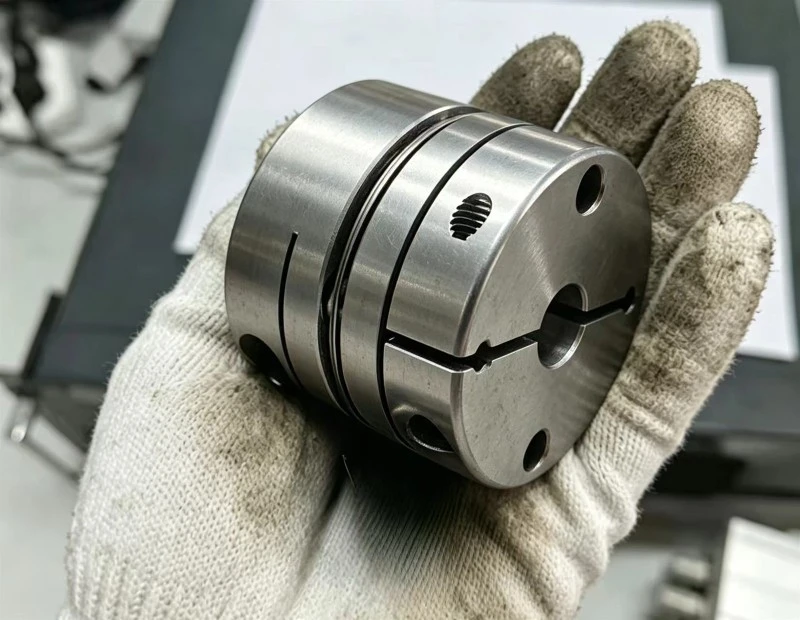
Product Showcase
Product Structure and Materials
The high-torque flexible coupling consists of three major modules: two metal hub halves, an intermediate elastic power-transmitting element, and a connecting locking unit. All hub blanks are primarily forged and undergo quenching and tempering to relieve residual stresses from machining. Core components include the half-coupling hubs, the shaft bore connection unit, the elastic power-transmitting element, locking fasteners, and a surface protective coating. Detailed structural parameters are shown in the table below:
| Structural Component | Brief Introduction | Core Requirements |
| Half‑coupling Hub | Torque input and output matrix, bears torsion and impact load to guarantee structural rigidity | 45# / 42CrMo forged quenched‑and‑tempered alloy steel, uniform metallographic structure, hardness HB240‑285. Keyway tolerance JS9, no cracking under heavy impact load. |
| Shaft‑hub Connection Unit | Realize torque connection between coupling and shaft, including keyway, clamping sleeve and locking‑assembly connection. | Keyway bore tolerance H7; coaxiality of clamping sleeve ≤0.02mm; locking‑assembly contact surface Ra≤1.6μm, no slipping under full torque. |
| Elastic Transmission Element | Core component for torque transmission, misalignment compensation and vibration damping. | Heavy‑duty jaw type:92‑95A high‑hardness polyurethane; serpentine spring:65Si2Mn spring steel HRC42‑48; tyre type:chloroprene rubber; large‑size diaphragm:301 stainless steel stacked sheets with excellent anti‑fatigue performance. |
| Locking Fasteners | High‑strength bolts and set screws for clamping and flange fastening. | Class 8.8 /10.9 high‑strength bolts, strength matching coupling nominal torque. Surface anti‑corrosion treatment to avoid rust seizure. |
| Surface Protection Layer | Anti‑rust and anti‑corrosion treatment for hubs to prevent assembly seizure. | Black oxide / phosphating coating; Dacromet or nickel‑plated coating for humid and slightly corrosive working conditions. |
In addition to the standard general-purpose structure, the following specialized models are available: a high-speed, heavy-duty dynamic-balanced version with overall dynamic balance correction to G6.3 grade; a high-temperature version featuring a metal elastic element without polymer components; an integrated coupler with a brake wheel, suitable for electric motor braking applications; and a short, compact version suitable for equipment with limited axial installation space.
Base Material Selection Criteria:
45# quenched and tempered steel hub: The primary general-purpose material, offering high cost-effectiveness and suitable for fans, pumps, and conveying equipment operating at normal temperatures with moderate impact loads.
42CrMo Alloy Steel Hub: The workhorse for heavy-duty impact applications, featuring excellent hardenability and higher torsional strength, making it suitable for frequent start-stop impact conditions in mining and extruder operations.
Selection Criteria for Elastic Elements: For heavy-duty impact applications at room temperature without oil, select high-hardness polyurethane; for applications involving contact with mineral oil, select tire-type neoprene; For high-temperature environments, select serpentine springs or stainless steel diaphragm metal elastic structures.
Key Points for Avoiding Operational Pitfalls: When calculating torque for selection, it must be multiplied by the operational impact safety factor; for heavy-duty impact equipment, the safety factor must not be less than 1.5, and for frequent forward-reverse cycling scenarios, the safety factor must be ≥2; shaft-bore fit tolerances must match-an excessively loose shaft diameter can easily cause slippage or keyway disengagement; polyurethane elastomers must not operate at temperatures exceeding 80°C for extended periods; Serpentine springs must be relubricated with grease at regular intervals; alignment deviations must not exceed the compensation limits specified in the product catalog; operating beyond these limits will cause rapid fatigue failure of the elastic elements.
Common Applications and Uses of the Product
High-torque flexible couplings are specifically designed for heavy-duty, alternating shock, and installation and thermal deformation offset conditions that also require vibration damping and compensation. They cover five core fields: fluid pumps and valves, mining conveyance, rubber and plastic extrusion, metallurgical auxiliary equipment, and heavy-duty automation:
High-Power Fans and Pumps: Industrial circulation pumps, induced draft fans, and dust collection fan motor-impeller shaft connections. These couplings compensate for thermal expansion misalignment between the motor and pump housing, absorb startup shocks, and reduce bearing vibration and temperature rise in pump units. Serpentine springs and tire-type couplings are widely used in these applications.
Mining and Material Handling Equipment: Heavy-duty belt conveyors, screw feeders, and the drive ends of fine-crushing auxiliary machinery. These applications must withstand peak impact loads caused by materials, transmit high torque while cushioning impacts, and reduce the likelihood of gearbox failures.
Rubber and Plastic Extrusion Machinery: At the motor-to-gearbox input end of single- and twin-screw extruders, where load fluctuations are significant and continuous heavy loads are present, heavy-duty claw-type or expansion sleeve-connected serpentine spring couplings are selected to prevent keyway damage caused by impact.
Metallurgical Auxiliary Equipment: Applications such as roller conveyors and auxiliary drives for cooling beds involve frequent starts and stops, as well as alternating loads from forward and reverse rotation; metal elastic high-torque flexible couplings are suitable for these conditions.
Heavy-Duty Automation Equipment: High-load tilting mechanisms and heavy-duty travel drive modules require both high torque and a certain degree of misalignment compensation; clamp-type or shrink-sleeve-connected heavy-duty star couplings are recommended.
In addition, they are widely used in heavy-duty transmission equipment such as large air compressors, mixing reactors, asphalt mixing plants, and small auxiliary machinery in ports.
Key Points for Precision Assembly
Statistics on heavy-duty equipment failures indicate that approximately 48% of failures involving premature damage to the elastic elements of high-torque flexible couplings and abnormal bearing overheating are caused by substandard alignment during assembly. Assembly must strictly adhere to the following four technical guidelines: cleaning of the shaft and coupling, alignment control, torque tightening of fasteners, and no-load verification and test operation:
Preliminary Cleaning and Parameter Verification
Use a cleaning agent to clean the shaft surface and the coupling bore, removing rust, burrs, metal shavings, and rust-preventive oil; verify that the coupling's nominal torque, elastic element material, and safety factor selection match the operating conditions; Inspect the hub for cracks or dents; check that the elastic elements show no signs of compression fractures or aging; ensure fasteners are intact and free of stripped threads; confirm the equipment's maximum allowable alignment deviation, strictly limiting the assembly control upper limit to 70% of the compensation value specified in the coupling manual-using the maximum compensation value directly is not permitted.
Coaxial Alignment and Pre-assembly Positioning
Install the two coupling halves onto the drive shaft and load shaft, respectively; do not force them into the shaft bores by striking them violently. Adjust the motor or gear unit base, and use a dial indicator to measure radial runout and end-face runout. Strictly control radial and angular misalignment, ensuring the assembly alignment value remains below the maximum allowable compensation limit specified in the catalog; Maintain the specified clearance between the two coupling halves; direct metal-to-metal contact or interference between the two hub halves is strictly prohibited.
Standard Torque Tightening of Fasteners
Keyway connections: Ensure the flat key is fully inserted into the keyway with no gaps on either side; for clamping sleeve and expansion sleeve couplings, tighten the bolts in two stages using a diagonal, alternating sequence, strictly adhering to the manufacturer's specified bolt tightening torque; do not tighten them fully in a single step. After assembling serpentine spring couplings, fill the spring tooth slots with the specified grade of grease.
Closed-Loop Verification Upon Assembly Completion
Manually rotate the entire drive chain; there should be no binding or abnormal metallic friction noises throughout the entire rotation. Record the actual radial and angular deviations upon assembly completion. Conduct a 30–60-minute no-load test run of the equipment to monitor the temperature rise of the motor and reducer bearings, as well as the vibration intensity of the entire unit. If vibration levels remain consistently high, re-verify the alignment accuracy.

Product Packaging Showcase
Frequently Asked Questions (FAQ)
|
Q: What causes the elastic elements of a new coupling to fracture after a few hundred hours of operation? A: There are three main causes: First, an insufficient safety factor during selection, resulting in peak impact torque exceeding the allowable value; second, on-site alignment deviations far exceeding the product's compensation limit, causing the elastic elements to undergo continuous fatigue deformation beyond their limits; third, operating temperatures exceeding the upper limit of the elastic elements' material temperature resistance, leading to deterioration of the polyurethane's high-temperature performance. Prioritize re-verifying the calculated torque and alignment accuracy.
Q: Why does a heavy-duty coupling experience slippage and insufficient torque transmission after a period of use? A: For keyway couplings, this is most likely due to key wear and rounding, resulting in excessive clearance between the key and the shaft bore. For clamping or expansion sleeve structures, the issue is often insufficient bolt tightening torque, or failure to clean rust and oil residue from the shaft surface. Under heavy-duty, impact-prone conditions, verify whether the instantaneous peak torque exceeds the coupling's load capacity.
Q: A serpentine spring coupling is producing abnormal noises during operation, and vibration is gradually increasing? A: The springs may be worn or broken, or the grease may have been depleted; alternatively, the alignment between the two coupling halves may be out of tolerance, causing the springs to continuously bear excessive misalignment loads. Shut down the equipment, open the housing to inspect the integrity of the springs, refill with grease, and recheck the alignment accuracy.
Q: Can a high-torque flexible coupling be directly replaced with a rigid coupling? A: This is not recommended. Rigid couplings offer no displacement compensation; even minor misalignments caused by equipment thermal expansion or foundation settlement can translate into significant additional loads, leading to rapid overheating and failure of the motor and gearbox bearings. A rigid coupling should only be considered in applications that achieve an extremely high level of permanent alignment and are free from thermal deformation.
Q: When it comes to alignment, is a smaller deviation always better? A: Ideally, the smaller the deviation, the better; however, zero deviation is unachievable for heavy-duty equipment. Keep assembly tolerances within 70% of the tolerance specified in the catalog. This protects the service life of the elastic elements while maximizing the design benefits of flexible compensation; there is no need to pursue absolute zero deviation.
Q: How do you choose between polyurethane elastomers and serpentine springs? A: For moderate impact and maintenance-free operation, select heavy-duty polyurethane star couplings; for continuous high temperatures and extreme alternating impact, where periodic maintenance and lubrication are permitted, select serpentine springs; ordinary polyurethane cannot be used in environments containing mineral oil.
Q: How do you choose between dynamic balance grades G6.3 and G12.5? A: For rotational speeds >1500 r/min under heavy-duty conditions, prioritize G6.3 precision dynamic balance; for lower rotational speeds below 1,000 r/min and general heavy-duty equipment with modest vibration requirements, select G12.5 standard-grade balancing.
Q: Why do tire-type rubber couplings develop rubber bulges and cracks? A: Causes include excessively high ambient temperatures, corrosion from mineral oil immersion, and prolonged operation beyond the allowable misalignment limit. Since rubber is a wear-and-tear component, couplings exhibiting cracks or bulges should be replaced immediately; they must not be operated while defective. |
References
GB/T 5272–2002 Star-shaped Elastic Couplings
GB/T 5844–2002 Tire-type Couplings
GB/T 12922–2008 Elastic Damping Couplings
Handbook of Mechanical Transmission Design, China Machinery Industry Press
Failure Analysis and Assembly Process Specifications for Heavy-Duty Flexible Couplings, Engineering Technology Handbook for Transmission Components
Contact Us
📧 Email: lsjiesheng@gmail.com
🌐 Official website: https://www.automation-js.com/


